The Translation Layer: Why Leadership Messages Fail and How Middle Managers Can Save Them
Only 7 percent of American employees strongly agree that the communication coming from their leadership is accurate, timely, and open. That figure, surfaced again and again in Gallup's State of the American Workplace research, is one of the most damning numbers in corporate life. It says that 93 out of every 100 people sitting in a town hall, reading an all-hands email, or watching a CEO video are walking away unconvinced. They may nod. They may applaud. They almost certainly will not act.
The instinctive response from the top of the org chart is to communicate more: more videos, more newsletters, more internal podcasts. The instinctive response from the middle is to translate, hedge, or quietly invent a version of the message that makes sense to the team standing in front of them. Neither response, on its own, fixes the underlying problem. The message is breaking somewhere between the executive who issued it and the employee who is supposed to live it. And the place it most often breaks is the layer in between.
The Cost of an Unclear Message
Gartner has reported that only 32 percent of employees say they understand how their organization's strategy applies to their own role. Read that twice. Two out of every three people on the payroll are unsure how their day connects to the plan their company has invested millions to produce. A separate study commissioned by Salesforce found that 86 percent of employees and executives cite ineffective communication as the primary cause of workplace failures. The cost is not theoretical. Towers Watson has tracked companies with highly effective internal communication and found they delivered 47 percent higher total returns to shareholders over a five year period than peers with poor communication.
The pattern that emerges from those numbers is consistent. When messaging is vague, people fill the silence. They fill it with rumor, with personal interpretation, with the version of the strategy that sounds best in their own voice. By the time the message reaches the floor, it has been edited so many times that no two teams are working from the same script.
Repetition Is the Job
Dave Ramsey, founder of Ramsey Solutions, has called himself the Chief Repeating Officer. His argument is blunt. By the time a leader is sick of saying something, employees are only just beginning to hear it. McKinsey research backs the instinct with a number. A strategic message must typically be repeated at least seven times, through varied channels, before employees internalize it.
Chick-fil-A learned the same lesson on a longer timeline. The chain's signature "my pleasure" response took years to land consistently in every restaurant, even with founder Truett Cathy championing it personally. The message was simple. The cultural rollout was not. Each new hire, each new shift leader, each new owner-operator had to hear the phrase, model the phrase, and reinforce the phrase until it became automatic. There was no shortcut, no campaign, no quarterly initiative that could compress the timeline. There was only the discipline of saying the same thing the same way for as long as it took.
Satya Nadella offered a more recent example. When he became CEO of Microsoft in 2014, he anchored the company's turnaround on two words: growth mindset. He used the phrase in town halls. He used it in performance reviews. He used it in product launches and earnings calls. Over time, employees stopped quoting Nadella and started using the language as their own. That is what internalization looks like. It is not a slogan on a poster. It is a phrase that has crossed the bloodstream of an organization and is showing up in meetings where the CEO is nowhere in sight.
The lesson for executives is uncomfortable. If you are tired of repeating yourself, you are probably halfway to being heard. Stopping now is the most expensive mistake you can make.
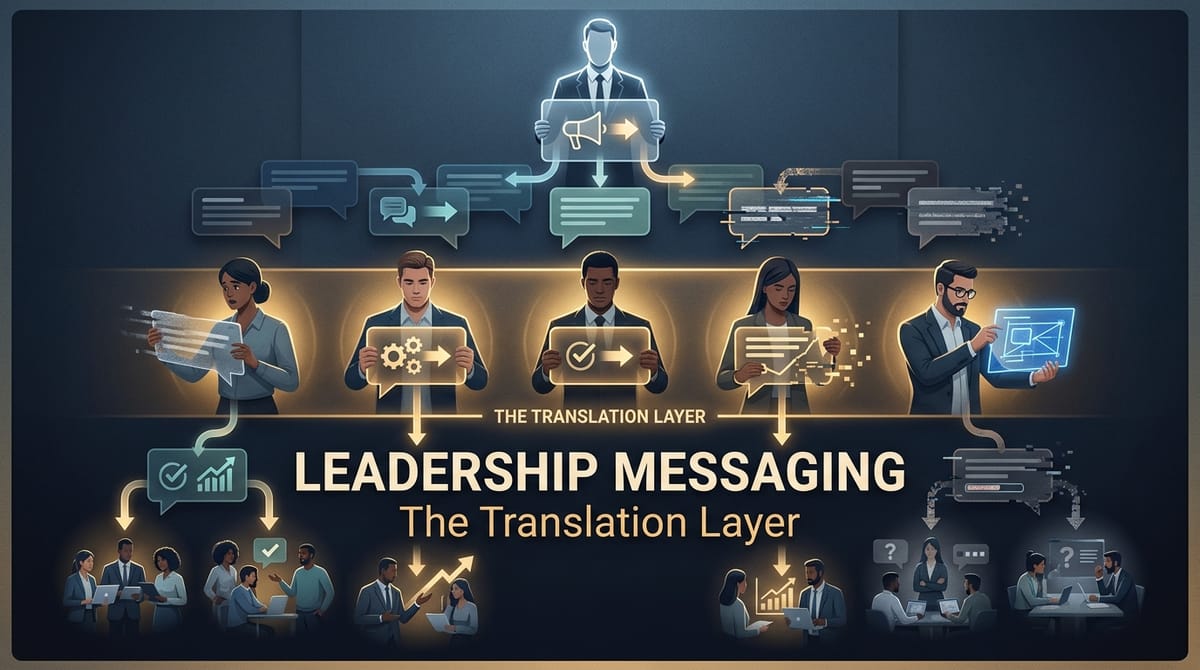
The Translation Layer
Even a perfectly repeated message rarely survives an entire organization without help. Gallup data attributes at least 70 percent of the variance in team engagement scores to the manager. Edelman's Trust Barometer shows that employees trust their direct manager more than they trust the CEO. Brunswick Group has found that employees are roughly three times more likely to act on a message they hear from their direct supervisor than from a CEO email.
Translation: the middle manager is not a passive conduit. The middle manager is the message.
That reality cuts both ways. When middle managers understand the strategy, believe in it, and can explain it in their own words, the message multiplies. When they do not, the same managers become the ceiling on every executive announcement. They will deliver the words because they have to. They will not deliver the conviction, because conviction cannot be faked at the team level. The people on a team know their manager. They can tell when a message is being read aloud and when it is being meant.
This is why a vague executive message is so dangerous. It does not produce silence. It produces six different versions of the strategy from six different managers, each one earnestly trying to make sense of what they were handed. Within a quarter, those six versions become the actual operating strategy of the company, and the executive who issued the original message has lost control of it without ever knowing.
The Right Kind of Push Back
The most useful thing a middle manager can do, when an executive message does not make sense, is to say so. Not to the team. To the executive.
That is not insubordination. It is quality control. If a message does not make sense to the manager who has been with the company for five years, it will not make sense to the new hire on the front line. Pushing back, asking for the underlying logic, and requesting examples of what the message looks like in practice are not signs of disloyalty. They are the work. A manager who absorbs a confusing directive and then performs confidence in front of the team is not protecting the executive. The manager is laundering a problem that will surface later, in worse form, with no clear owner.
Executives who want their messages to survive need to make this kind of push back safe and routine. That means inviting questions before the cascade, not after. It means treating manager confusion as data, not as an attitude problem. It means rewriting a message when three managers ask the same clarifying question, because that is three teams away from a misalignment the executive will eventually have to clean up.
Middle managers, for their part, need to push back early, push back specifically, and push back in private. The goal is not to win an argument. The goal is to leave the conversation with a message they can carry honestly.
Hybrid Work and the Loss of Cues
The translation layer used to have a quiet advantage. People worked in the same building. A manager could read the room after a town hall, watch how people walked back to their desks, and hear the first unfiltered reactions over coffee. Tone of voice, body language, and the small gestures of a face all carried information. None of that survives a Zoom grid or a Slack thread cleanly.
Hybrid and remote work have not made messaging harder in theory. They have made it harder to detect when messaging has failed. A confused team in an office radiates confusion. A confused team on video looks identical to a focused team. The non verbal cues that once told a manager to slow down and re explain are now muted, delayed, or missing entirely. That puts more weight, not less, on explicit follow up. Asking a team member to restate the strategy in their own words, in writing, is now one of the most valuable five minute exercises a manager can run.
A Short Playbook
For executives, the moves are straightforward. Pick one message. Repeat it past the point of personal boredom. Reinforce it in writing, in video, in performance reviews, and in the small operational rituals where employees actually pay attention. Invite manager push back early and treat repeated questions as a signal to revise. Match your behavior to your message every time, because employees grade tone against action and discard whichever one feels less honest.
For middle managers, the moves are equally clear. Demand clarity before you cascade. Paraphrase the message back to the executive and ask whether you got it right. Translate the message into your team's vocabulary without changing its meaning. Repeat it across at least three channels, including one that asks for a response. Close the loop upward by reporting what is landing and what is not. When something does not make sense, push back in private and push back specifically. Your team is reading you, not the email.
The Question That Lands for Everyone
A message that survives every layer of an organization is the only one that ever truly existed. Everything else is intention. If your team had to repeat the strategy in their own words tomorrow, in their own voices, with no script in front of them, what would they say. And would you be proud of it.
The answer, for executives and middle managers alike, is the only honest measure of whether the message has been heard.
Sources
- Gallup, State of the American Workplace
- Gartner HR Practice, employee strategy alignment research
- McKinsey & Company, organizational health and message internalization research
- Towers Watson, internal communication and shareholder return study
- Salesforce-commissioned communication study
- Edelman Trust Barometer
- Brunswick Group, internal communication research
- Dave Ramsey, EntreLeadership
- S. Truett Cathy, Eat Mor Chikin: Inspire More People
- Satya Nadella, Hit Refresh