Everyone Wants Feedback. Almost No One Feels Safe Giving It.
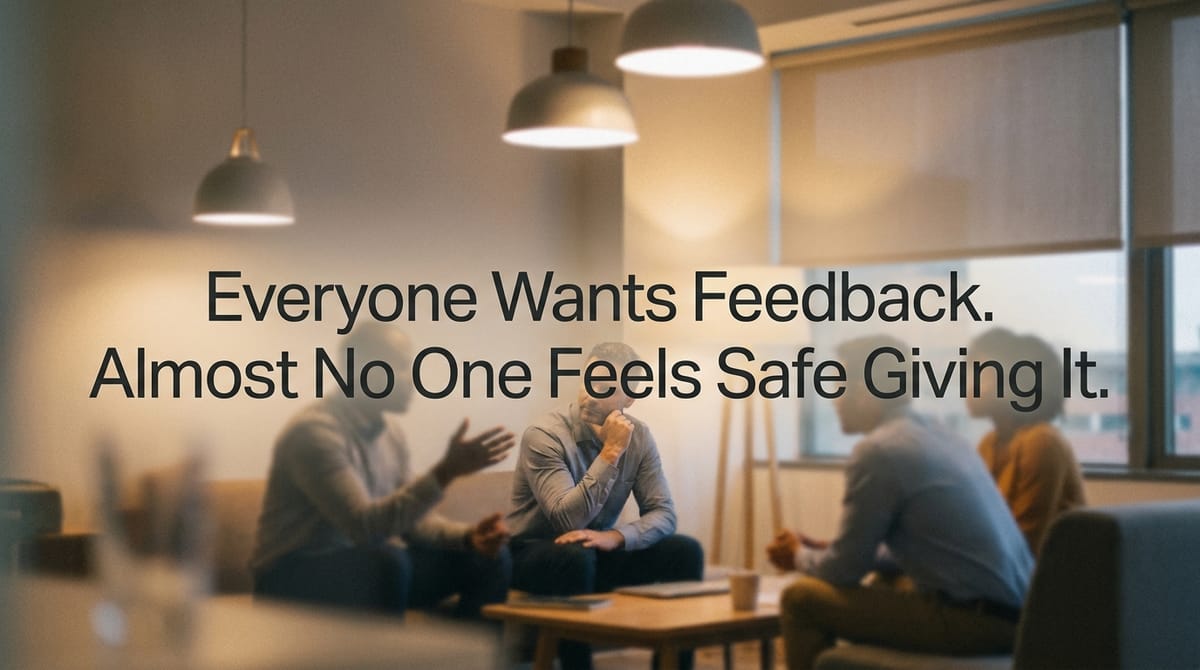
Ask people whether they want feedback at work and the answer is almost unanimous. In a Workleap survey, 96% of workers said regular feedback benefits them, and 83% said they appreciate it whether the message is flattering or hard to hear. Now ask whether they actually feel safe giving honest feedback to the people they work with, and the picture collapses. A recent Brightmine survey found that only 36% of employees feel truly safe doing it. We say we want this. We say we value it. We just don't do it.
That is the contradiction worth sitting with. The desire is not the problem. Something stands between the want and the act.
A skill gap, an emotional intelligence gap, and a cultural one
When feedback fails inside an organization, the usual reflex is to blame fear. Fear of retaliation. Fear of being seen as difficult. Fear of being labeled "not a team player." Fear is real, but it is downstream of three more fundamental gaps.
The first is a skill gap. Most professionals have never been taught how to give feedback in a way that lands. We learn it the way we learned to swim before lessons existed: by falling in and hoping. People who give feedback poorly are usually not unkind. They are unskilled. They lead with verdicts instead of observations, they pile on examples instead of choosing one, and they confuse honesty with bluntness. The reaction they get teaches them never to try again.
The second, and the one that drives most of the breakdowns, is an emotional intelligence gap. Giving good feedback is an emotional task before it is a communication task. It requires self-awareness about your own motivation for raising the issue. It requires reading the other person in the moment, sensing whether they are ready to hear it. It requires regulating your own discomfort so you do not soften the message into uselessness or sharpen it into an attack. And on the receiving end, it requires the much harder work of staying open when every instinct is to defend yourself. A leader without emotional intelligence does not just give poor feedback. They make every person around them quieter.
The third is cultural inertia, and it works on two levels at once. Some national and ethnic cultures place a high value on deference to authority. Questioning a manager, especially in public, is not just uncomfortable; it is socially costly. Hofstede's work on power distance described this decades ago, and it shapes the experience of millions of employees today, particularly in global organizations where teams cross those lines. But organizational culture matters just as much. Some companies have spent years signaling, often without realizing it, that pushback ends careers. Once that signal is embedded, no all-hands meeting that ends with "my door is always open" will undo it.
If you are a leader trying to fix feedback inside your team, this is where you start. Not with a new tool. Not with a new survey vendor. With an honest assessment of the skill, the emotional capacity, and the cultural undertow operating beneath the surface.
Annual reviews are autopsies. Feedback should be preventive care.
For decades, the annual performance review has carried more weight than it can possibly bear. We treat it as the moment when feedback happens, as if eleven months of silence and one hour of structured conversation will magically produce growth. By the time an annual review surfaces a concern, the moment to act on it has often already passed. It is an autopsy on a year you cannot get back.
Continuous feedback is preventive care. It treats small course corrections as routine and inexpensive instead of saving everything up for one anxious appointment. It tells people what they need to know while they can still do something about it. It also normalizes the act itself, which is the only thing that ever truly lowers the temperature in the room.
But cadence alone is a trap. Adding more 1:1s, more pulse surveys, and more skip-levels does not produce a feedback culture if the feedback ends up in the same place it always did, which is nowhere. The number of organizations running thoughtful, frequent listening sessions whose output never reaches a decision is hard to overstate. Frequent silence is still silence.
Feedback needs a destination, an owner, and a visible outcome
This is the part most companies skip. They build channels and forget the pipeline.
Imagine a piece of upward feedback in your organization right now. A frontline employee raises a concern about a process that wastes time and morale. Where does that observation go? Who reads it? Who decides whether to act on it? When and how is the employee told what happened? If you cannot answer those questions cleanly, the feedback culture you think you have is mostly theater.
Every piece of feedback worth collecting needs three things: a destination so it does not vanish, an owner so it does not orphan, and a visible outcome so the person who offered it knows their effort mattered. The form that takes will vary. It might be a leadership dashboard that tracks themes and the actions taken against them. It might be a lightweight ticket queue where each item has a status of received, reviewed, addressed, or declined with reason. It might be a monthly recap from leadership that names what was heard and what is changing as a result. The specific format matters less than the discipline of closing the loop.
The NHS Trust SPEaC-app pilot offered a useful proof point. By giving frontline staff a real-time, anonymous channel to flag concerns, and crucially by feeding those concerns back into operational decisions, the trust significantly improved staff engagement scores over its baseline annual survey. The channel was not the magic. The action on what came through it was.
Without that visible outcome, employees draw the only logical conclusion: nothing changes when they speak, so why speak. Nine times out of ten, the death of a feedback culture is not retaliation. It is unread inboxes.
Feedback has to move in every direction
Most organizations handle one direction of feedback reasonably well. Managers give it to their employees, often in the form of performance notes, coaching, or correction. The harder directions are the ones that get neglected.
Employees need to be able to give feedback to their managers. That is the direction that benefits the organization the most and frightens managers the most. It is also the direction where emotional intelligence matters most acutely, because how a manager receives that first piece of hard upward feedback sets the ceiling for every piece of feedback that follows. Defensiveness does not just kill the moment. It quietly terminates the channel.
And when the feedback is about the manager, that manager's own leader should hear it too. This is not tattling. It is healthy oversight, and it solves a structural problem that simple "talk to your manager" guidance cannot solve. A frontline employee should not be the lone person responsible for fixing a manager whose behavior is the issue. Senior leaders need visibility into patterns, not so they can punish, but so they can coach, support, or in rare cases, intervene. Framing this as a routine norm rather than a dramatic escalation is the trick. When everyone expects that hard feedback about a leader will travel one level up as a matter of course, no one has to nerve themselves up to "report" anything. It is just how the system breathes.
This works only if it is anchored in a real culture of respect. Senior leaders cannot weaponize what they hear. Managers cannot retaliate against employees who go around them. The notification is for context and coaching, not for ammunition. Without that discipline, the practice becomes corrosive fast.
Two channels, not one
Direct conversation is the gold standard. Done well, it builds trust faster than any other intervention. But pretending direct conversation is the only legitimate channel is a leadership blind spot. Plenty of capable, valuable people do not do well with confrontation, and a few of them have something important to say that the organization needs to hear. Anxiety about direct conversation does not invalidate the feedback underneath it.
Anonymous channels are not a workaround for cowardice. They are a release valve for people whose voice would otherwise be lost entirely: people who carry the weight of cultural norms that punish dissent, people raising sensitive issues that could affect their employment, people who simply find direct conflict overwhelming. A well-run anonymous channel sits next to direct conversation, not in place of it.
Neither channel works on its own. Direct-only cultures lose the voices that struggle to confront. Anonymous-only cultures lose the trust that comes from being seen and heard as a person. You want both, you want the boundary between them clearly understood, and you want the same destination, owner, and visible outcome on both.
The quiet cost, and a warning
There is a price to all of this not happening. When employees self-censor at scale, organizations pay in productivity, in turnover, in missed innovation, and in customers lost to problems no one was willing to surface. The cost is real and worth naming, but it is not the reason to do this work. The reason is simpler. People deserve to be heard at the place where they spend most of their waking hours.
A short warning is in order, too. There are companies that have leaned hard into candor cultures, demanding radical transparency and rewarding bluntness as a virtue. Some of them are admired. Some of them are also exhausting, anxious places to work, where critique has been let off its leash without the emotional intelligence to guide it. Honesty without safety becomes brutality. The goal is not a louder workplace. The goal is a workplace where what needs to be said can be said.
What happens in the next ten seconds
If you take one idea from this, take this one. The next time someone you manage says something hard to you, watch what you do in the first ten seconds. The pause before you respond. The slight tightening of your jaw, or your effort to keep it loose. The instinct to explain yourself, or the discipline to ask one more question. The thank-you that sounds genuine, or the one that sounds rehearsed.
Those ten seconds set the ceiling. Everything you build on top of that moment, the dashboards, the pipelines, the anonymous forms, the cross-team listening tours, all of it lives or dies in how you behave when the words land.
The feedback your team is not giving you is not absent. It is just somewhere else. The work, quietly and patiently, is to build the kind of leader, and the kind of organization, that earns it back.
Sources
- Workleap, State of Employee Engagement, 2021 (96% / 83% statistics).
- Brightmine, Building a Fearless Culture: Survey Highlights Psychological Safety Gap, 2025 (36% statistic).
- Gallup, How Effective Feedback Fuels Performance (engagement and feedback frequency data).
- Amy Edmondson, The Fearless Organization, and Google re:Work / Project Aristotle (psychological safety foundation).
- Geert Hofstede, Cultures and Organizations: Software of the Mind (power-distance and cultural inertia).
- PMC / NCBI, Using real-time, anonymous staff feedback to improve staff experience and engagement (NHS Trust SPEaC-app pilot).