Microsoft Builds In-House AI Models to Cut OpenAI Costs
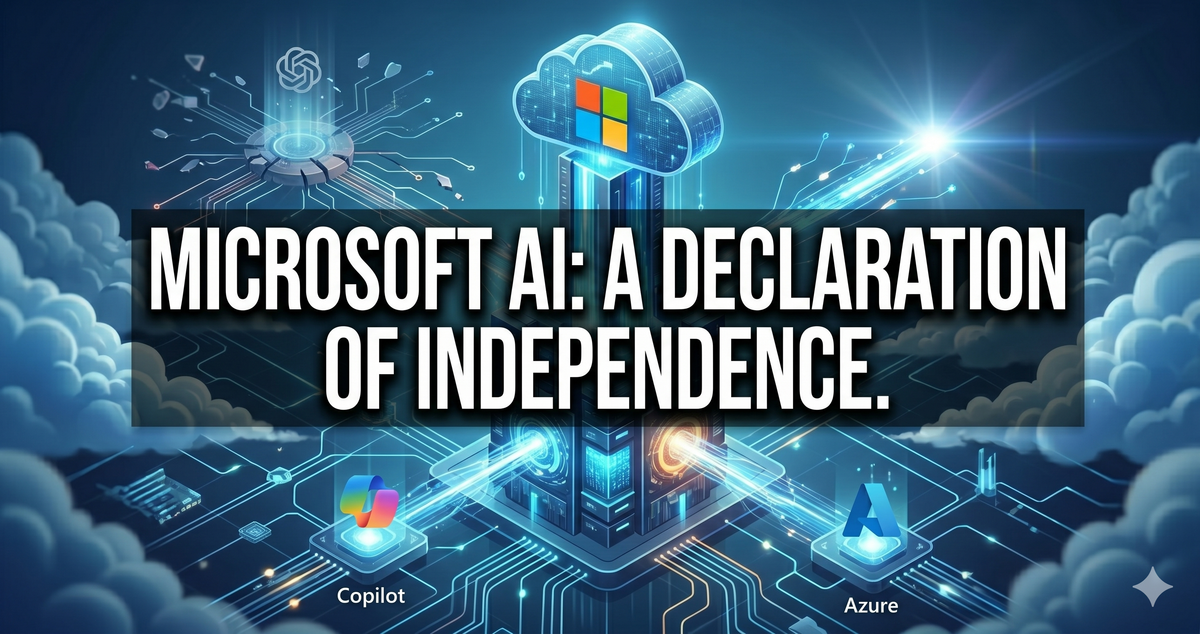
When Microsoft took the stage at its Build developer conference on June 2, 2026, the headline was not a new partnership but a declaration of independence: a family of seven in-house "MAI" models spanning reasoning, coding, voice, image, and transcription.[1][2] The launch, led by Microsoft AI chief Mustafa Suleyman, caps a year in which the company quietly rebuilt itself from OpenAI's largest backer and cloud host into a model maker in its own right.
The move lands just weeks after the two firms rewrote their agreement to make Microsoft's access to OpenAI's technology non-exclusive and to end the revenue share Microsoft had been paying.[3][4] The throughline is not a breakup, but cost and control.
What Microsoft Announced
Microsoft framed the seven-model MAI family as a bid for long-term self-sufficiency and reduced reliance on outside model providers, including OpenAI.[1][2] The flagship is MAI-Thinking-1, a reasoning model that, according to the company, carries 35 billion active parameters and a 256,000-token context window and was trained from scratch with no "distillation" — the practice of training a new model on the outputs of an existing one — from other companies' systems.[5][6]
Microsoft says MAI-Thinking-1 was preferred over Anthropic's Claude Sonnet 4.6 in blind testing and matched Claude Opus 4.6 on the SWE-Bench Pro coding benchmark, a test of how well models resolve real software-engineering tasks.[5] Those results reflect the company's own evaluations and have not yet been independently verified.
The rest of the lineup pushes Microsoft across the AI stack: MAI-Code-1-Flash, a lightweight coding model built into GitHub Copilot and Visual Studio Code, alongside media models MAI-Voice-1, MAI-Transcribe-1, and MAI-Image-2, available to developers through Microsoft Foundry.[7][8]
Why Now: The Economics of the "OpenAI Tax"
The clearest theme running through the launch is cost. Microsoft positioned its medium-sized reasoning model as built for "high efficiency" at a "low-token cost" — tokens being the units of data that determine what developers pay to run a model.[2] On the media side, the company says MAI-Transcribe-1 delivers speech recognition across 25 languages at roughly 50 percent lower GPU cost than leading alternatives.[8]
Those economics matter because Microsoft owns the underlying infrastructure. Running first-party models on its own Azure data centers lets the company capture margin it would otherwise pay to an outside lab — the recurring "OpenAI tax" that has accompanied its reliance on a single frontier provider.[9]
The Partnership, Rewritten
The MAI push cannot be separated from the rapid reworking of the Microsoft–OpenAI relationship. Microsoft first invested in OpenAI in 2019 and has since committed roughly $13 billion, gaining exclusive intellectual-property rights and the role of OpenAI's frontier-model partner — the arrangement that powered Copilot and the Azure OpenAI Service.[2][10]
That structure has been renegotiated twice in roughly six months. An October 28, 2025 agreement cleared the way for OpenAI to recapitalize as a public benefit corporation, leaving Microsoft with a stake of about 27 percent valued near $135 billion, while stripping Microsoft of its right of first refusal to serve as OpenAI's compute provider.[10][11]
A second amendment, announced April 27, 2026, went further: Microsoft's license to OpenAI's IP runs through 2032 but is now non-exclusive, Microsoft no longer pays a revenue share to OpenAI, and OpenAI's revenue-share payments to Microsoft are capped and decoupled from any future declaration that the lab has reached artificial general intelligence.[3][4] Taken together, the changes loosen the ties that once bound the two companies tightly to each other.
Hedge, Not Break
Both companies insist the relationship is intact. In a February 27, 2026 joint statement, Microsoft and OpenAI described their partnership as remaining "strong and central," and OpenAI has publicly framed the April amendments as simplifying how the two work together.[12][13] Analysts have characterized the in-house model program as a hedge rather than a break — a way for Microsoft to operate at more layers of the AI stack without walking away from OpenAI's frontier research.[9]
The competitive backdrop reinforces that reading. Microsoft has invested roughly $5 billion in Anthropic while offering its models on Azure, and it has reportedly explored acquiring AI startups — including Inception, a Stanford-linked company pursuing diffusion-based language models — to further diversify.[2][14] The diversification comes as both OpenAI and Anthropic march toward public markets; Anthropic confidentially filed for an initial public offering on June 1, 2026.[2]
What's Still Unknown
Several questions remain open. Microsoft has not disclosed the training-data sources for the MAI models, a gap that analysts say will matter to enterprise customers weighing intellectual-property and compliance exposure.[9] The company's performance claims also await independent benchmarking, and it is not yet clear how aggressively — or on what timeline — Microsoft will route Copilot's core experiences to its own models rather than OpenAI's. For now, the direction of travel is unmistakable: Microsoft intends to own more of the stack it once rented.
Sidebar / Key Takeaways
- Microsoft unveiled seven in-house "MAI" models at Build 2026, spanning reasoning, coding, voice, image, and transcription.
- The flagship MAI-Thinking-1 (35B active parameters, 256K context, trained without distillation) is pitched at enterprises — though its benchmark wins are Microsoft's own, not independently verified.
- Cost is the core theme: low-token-cost reasoning and a claimed ~50% lower GPU cost for transcription, made possible by Microsoft's own Azure infrastructure.
- The launch follows two renegotiations of the OpenAI deal in six months, ending Microsoft's revenue share to OpenAI and making its IP license non-exclusive through 2032.
- Both firms call the partnership "strong and central"; analysts read MAI as a hedge, not a break.
Sources
- Quartz — "Microsoft launches 7 in-house AI models to reduce reliance on OpenAI," Jun 2026. https://qz.com/microsoft-mai-ai-models-openai-reliance-060326
- CNBC — "Microsoft unveils new AI models to lessen reliance on OpenAI and lower costs for developers," Jordan Novet, Jun 2, 2026. https://www.cnbc.com/2026/06/02/microsoft-unveils-new-ai-models-lessen-reliance-on-openai-lower-costs.html
- The Verge — "Microsoft's first advanced reasoning AI is here," Jay Peters, Jun 2, 2026. https://www.theverge.com/tech/941664/microsoft-ai-model-reasoning-mai-thinking-1-build-2026
- Yahoo Finance — "Microsoft launches MAI AI models to reduce OpenAI reliance," 2026. https://finance.yahoo.com/sectors/technology/articles/microsoft-launches-mai-ai-models-133559358.html
- Windows Central — "Microsoft launches seven in-house AI models to cut developer costs and reduce reliance on OpenAI," Sean Endicott, Jun 3, 2026. https://www.windowscentral.com/software-apps/microsoft-launches-seven-in-house-ai-models-to-cut-developer-costs-and-reduce-reliance-on-openai
- Microsoft Community Hub — "Introducing MAI-Transcribe-1, MAI-Voice-1, and MAI-Image-2 in Microsoft Foundry," 2026. https://techcommunity.microsoft.com/blog/azure-ai-foundry-blog/introducing-mai-transcribe-1-mai-voice-1-and-mai-image-2-in-microsoft-foundry/4507787
- Forbes — "Microsoft Builds Its Own AI Model Stack To Reduce OpenAI Dependence," Janakiram MSV, Apr 2, 2026. https://www.forbes.com/sites/janakirammsv/2026/04/02/microsoft-builds-its-own-ai-model-stack-to-reduce-openai-dependence/
- The Official Microsoft Blog — "The next chapter of the Microsoft–OpenAI partnership," Oct 28, 2025. https://blogs.microsoft.com/blog/2025/10/28/the-next-chapter-of-the-microsoft-openai-partnership/
- The Official Microsoft Blog — "The next phase of the Microsoft-OpenAI partnership," Apr 27, 2026. https://blogs.microsoft.com/blog/2026/04/27/the-next-phase-of-the-microsoft-openai-partnership/
- The Official Microsoft Blog — "Microsoft and OpenAI joint statement on continuing partnership," Feb 27, 2026. https://blogs.microsoft.com/blog/2026/02/27/microsoft-and-openai-joint-statement-on-continuing-partnership/
- Reuters — "Microsoft, OpenAI reach deal removing fundraising constraints for ChatGPT maker," Oct 28, 2025. https://www.reuters.com/business/microsoft-openai-reach-new-deal-allow-openai-restructure-2025-10-28/
- Business Insider — "OpenAI and Microsoft renegotiated their deal for the second time in 6 months," Apr 2026. https://www.businessinsider.com/openai-microsoft-partnership-agreement-changes-cloud-providers-agi-2026-4
- OpenAI — "The next phase of the Microsoft OpenAI partnership," Apr 2026. https://openai.com/index/next-phase-of-microsoft-partnership/
- ET Enterprise AI — "Microsoft exploring AI startup deals to reduce dependence on OpenAI: Report," 2026. https://enterpriseai.economictimes.indiatimes.com/news/industry/microsoft-eyes-ai-startup-acquisitions-to-reduce-reliance-on-openai/131083527