Work About Work: A System to Reclaim Your Focus Time
60% of Your Day Is Work About Work. Here's How to Get It Back.
I have known for years that my brain does not sit still. I will open a document to write a report, notice an email, answer it, catch a new message, chase a link, and twenty minutes later realize I have not written a single sentence of the report. For a long time I blamed myself. Then I started measuring where my time actually went, and the data told a more useful story. I was not lazy or undisciplined. I was drowning in work about work.
If you have ever finished a ten hour day feeling wrung out yet unable to name one meaningful thing you produced, you already understand the problem. Research from Asana found that knowledge workers spend roughly 60% of their time on work about work, the coordination layer of status updates, searching for information, and switching between tools, which leaves only 40% for the skilled work they were hired to do.[1] The figure is startling precisely because it feels so ordinary. Most of us never notice the tax, because paying it feels like working.
What work about work actually costs you
Work about work is the busywork that surrounds real work without ever becoming it. Chasing approvals. Hunting for a file. Rewriting the same update in three different channels. Sitting through a meeting that repeats what an email already said.
The interruptions are relentless. Microsoft's analysis of Microsoft 365 activity found that employees are interrupted every two minutes during the workday, about 275 times a day, by meetings, emails, and chat notifications.[2] Each interruption carries a hidden recovery cost. Gloria Mark's research at the University of California, Irvine found that it takes an average of 23 minutes and 15 seconds to return to a task after being pulled away.[3] Run that against 275 interruptions and the picture is grim. There is barely any uninterrupted time left for the kind of work that needs a running start.
For someone with an ADHD brain like mine, this environment is quicksand. I do not need much of an excuse to switch tasks. Modern work hands me a fresh one every two minutes.
The first fix: see where your time really goes
You cannot protect something you cannot see. The single most eye opening thing I have done is track my time by category rather than by task.
Here is the distinction that makes it stick. I do not log "drafted section three of the interoperability report." I log a bucket. My categories are simple:
- Project Work
- Education
- Reading
- Personal
- Fitness and Wellness
- Leisure
Task level tracking collapses because it is too much work. Category tracking survives because it is nearly frictionless. I built a small script tied to a hotkey. I press the key, a popup appears, and I choose what I am doing entirely from the keyboard without ever reaching for the mouse. It takes about two seconds. I am now experimenting with an external keypad so a single physical button can switch my active category with no popup at all.
The gadget is not the point. Friction is the point. If measuring your time is a chore, you will quit within a week. Make it a reflex and it becomes a mirror.
What did my mirror show me? Exactly what I feared. I bounce. I rarely drop into sustained deep work, and the day gets eaten in small, invisible bites. That was uncomfortable to see on paper, but seeing it is what let me start to change it. Data does not fix the problem. It just ends the denial.
The biggest offender: meetings that should have been emails
Once you can see your time, one category tends to balloon past what you expected. For most people, it is meetings.
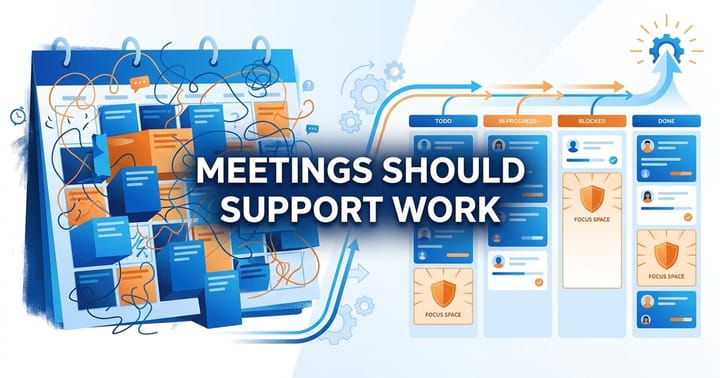
I have sat through a lot of them. As a public board member, I have watched skilled people run tight, purposeful sessions, and I have watched groups burn an hour going in circles. The difference is almost never the people. It is whether two things existed before anyone sat down: a clear agenda and a defined objective.
That is my rule, and I call it the Meeting Gate. If a session does not have an agenda and a stated objective, it does not get to be a meeting. It is a strict filter, and the data backs it up. Flowtrace's State of Meetings analysis, drawn from more than a million calendar events, found that over 60% of meetings have no agenda at all, and that the average employee now burns close to 392 hours a year in meetings, a large share of them unproductive.[4]
My least favorite species is the standing status meeting. Recurring weekly check ins where everyone reports what they did are, in my experience, a trap. They train people to sandbag. Work drifts until the day before the meeting, then everyone scrambles to have something to say. The cadence becomes the deadline, and the deadline becomes theater.
Replace status meetings with an async pipeline
Here is the part that takes a little courage. Most standing meetings can be replaced by a written pipeline that runs continuously instead of firing once a week.
The tool matters far less than the habit. It can be a shared document, a project channel, or something as humble as an email thread with the project name in the subject line. People post updates as the work happens. Questions can be asked at any moment and answered in the open, where the whole team can see the record. If leadership wants a synthesis, a project manager can post a written recap once a week. None of that requires pulling six people into a room.
Some will object that this creates too many emails. I would argue that is exactly what email is for. Asynchronous communication with a durable record is the entire value proposition. A thread you can search beats a meeting you have to remember.
This is also where honesty is required. Moving a team off standing meetings genuinely needs buy in from higher up, and not everyone has that authority. If you are an individual contributor, you probably cannot abolish the weekly status call on your own. What you can do is nudge. Suggest an agenda. Ask what the objective is. Propose that a recurring update move to a shared doc for a month as a trial. Small structural suggestions, offered without hostility, move a culture further than grand declarations ever will.
Not every meeting is the enemy
I want to be clear, because it would be easy to read all of this as anti meeting. It is not. Some meetings are worth protecting fiercely.
The ones that build relationships earn their place. Time spent understanding a colleague, mentoring someone, or sitting across from a client to build trust is not work about work. It is the work. The goal is never to eliminate human connection. It is to stop letting low value coordination crowd it out.
Systems beat willpower
The temptation with a topic like this is to promise that if you just try harder, focus more, and resist the pings, you will win your day back. I do not believe that, because I have lived the opposite. My attention is unreliable by default. Willpower is not a plan.
What works is building systems that make the right thing the easy thing. A two second tracker that shows me the truth. A gate that keeps pointless meetings off my calendar. A written pipeline that makes the standing meeting unnecessary. None of these depend on me being disciplined in the moment, which is exactly why they hold.
The tools everyone is counting on to rescue us have the same weakness. AI genuinely does save time. The Federal Reserve Bank of St. Louis found that workers using generative AI save about 5.4% of their hours, roughly 2.2 hours a week.[5] But saved time evaporates without a system to catch it. Boston Consulting Group found that 66% of employees who save time with AI get little or no guidance on what to do with the hours they free up, and most never reinvest them into higher value work.[6] The lesson is the one my hotkey taught me. A tool without a system just gives you a faster way to stay busy.
So start with the mirror. Track your time by category for two weeks and look honestly at what it shows you. Then put one system in place to protect the time that matters, whether that is a Meeting Gate or a shared thread that retires a standing call. You will not claw back all 60%. But you will stop paying the tax without noticing, and the hours you recover will be the ones that were worth having in the first place.
Sources
- Asana, "How Work About Work Gets in the Way of Real Work," https://asana.com/resources/why-work-about-work-is-bad
- Microsoft WorkLab, "Breaking down the infinite workday," 2025, https://www.microsoft.com/en-us/worklab/work-trend-index/breaking-down-infinite-workday
- Gloria Mark, Daniela Gudith, and Ulrich Klocke, "The Cost of Interrupted Work: More Speed and Stress," University of California, Irvine, https://www.ics.uci.edu/~gmark/chi08-mark.pdf
- Flowtrace, "State of Meetings Report 2025," https://www.flowtrace.co/collaboration-blog/state-of-meetings-report
- Federal Reserve Bank of St. Louis, "The Impact of Generative AI on Work Productivity," Bick, Blandin, and Deming, 2025, https://www.stlouisfed.org/on-the-economy/2025/feb/impact-generative-ai-work-productivity
- Boston Consulting Group, "AI at Work: Why Strategy Matters More Than Tools," 2026, https://www.bcg.com/publications/2026/ai-at-work-why-strategy-matters-more-than-tools