How to Reduce Unnecessary Meetings Without Losing Focus
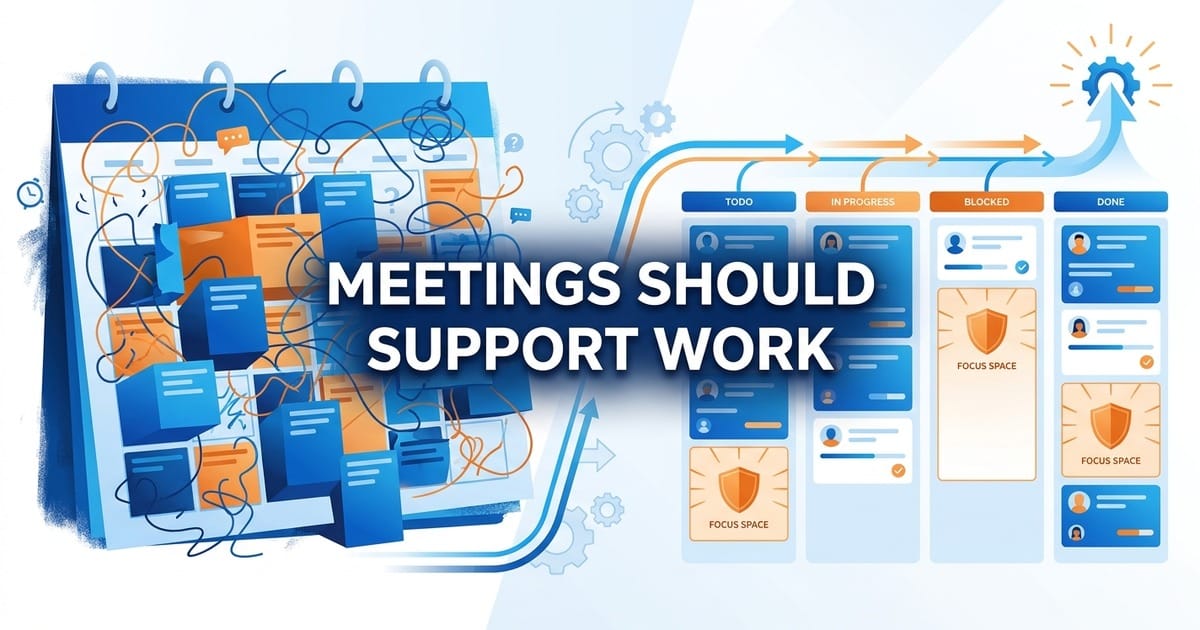
Meetings Should Support the Work, Not Manage It
I know the pattern because I sometimes fall into it myself.
A project meeting is approaching, and an action item has been sitting on my list. It mattered when I accepted it, but other priorities kept arriving. I deferred it once, then again. A few hours before the weekly touchbase, the calendar reminder changes the equation. The task suddenly becomes urgent because I know I will be asked about it.
That burst of urgency may produce an update, but it is not a healthy way to manage work. The meeting has become the deadline, the status system, and the accountability mechanism all at once.
If you are trying to learn how to reduce unnecessary meetings, start by looking beyond the calendar. A team cannot remove status meetings safely if those meetings are the only place where progress becomes visible. The better approach is to manage work continuously, then use meetings for the conversations that genuinely require people to be together.
How to Reduce Unnecessary Meetings Between Touchbases
The first step is to separate the work from the meeting about the work.
A project board, dashboard, or shared workspace should show what is happening without requiring everyone to wait until Friday morning. At minimum, each meaningful action should have:
- A clear description of the work
- One accountable owner
- A deadline or expected review date
- A current status
- Any blocker requiring attention
- The date of the latest update
This sounds basic, but it changes the role of a weekly touchbase. Instead of moving around the room for status reports, the team can review the board beforehand. If everything is progressing and no decision is required, the meeting may not be necessary. If a dependency is stuck or two teams disagree about the path forward, live discussion can help.
This distinction matters for individual contributors as much as it does for leaders. A manager may control the calendar, but an individual contributor can still ask useful questions: Could I post this update in the project board? What decision do we need from the meeting? Who needs to participate in that decision?
Those questions are not resistance to collaboration. They are attempts to protect it from becoming performative.
The Hidden Cost of Using Meetings as a Management System
Meetings become expensive long before anyone adds up salaries.
Atlassian surveyed 5,000 knowledge workers and found that meetings were ineffective 72 percent of the time. Seventy-eight percent said they were expected to attend so many meetings that getting their work done became difficult. More than half frequently left without a clear understanding of the next steps or who owned them.1
Harvard Business Review reported that executives spent nearly 23 hours a week in meetings, compared with fewer than 10 hours in the 1960s.2 The calendar entry captures only part of that cost. A one-hour meeting with eight participants consumes eight hours before accounting for preparation, follow-up, context switching, or the focused work that each person postponed.
There is also a behavioral cost. When the next standing meeting becomes the moment when progress will be inspected, people can begin organizing their work around that inspection. Tasks stay quiet for days and then receive a rush of attention immediately before the call. The meeting creates activity, but it may also hide weak prioritization, unclear ownership, and poor visibility.
Canceling the meeting without fixing those conditions would not solve the problem. The work might simply disappear from view.
Decide What Deserves Live Time
A useful meeting should accomplish something that a report cannot.
Status information, routine metrics, completed-task lists, and straightforward announcements can usually travel asynchronously. Put the report in the agenda or shared workspace and let people review it when they have the attention to absorb it. If the information raises a question, schedule a focused conversation with the people needed to answer it.
Live time is more valuable when the work requires:
- A decision with meaningful tradeoffs
- Discussion of a complex or ambiguous problem
- Coordination across dependencies
- Resolution of disagreement or risk
- Relationship-building that benefits from real conversation
Shopify tested a forceful version of this distinction in 2023. The company automatically canceled recurring meetings with three or more people, asked employees not to restore them for at least two weeks, reinstated meeting-free Wednesdays, and limited large meetings to a defined Thursday window.3 The lesson is not that every company should copy Shopify. It is that recurring meetings should have to re-earn their place on the calendar.
A simple renewal test can help. Every standing meeting should have an owner, a written purpose, required participants, an expected output, an appropriate cadence, and a date when the group will reconsider whether it still needs to exist.
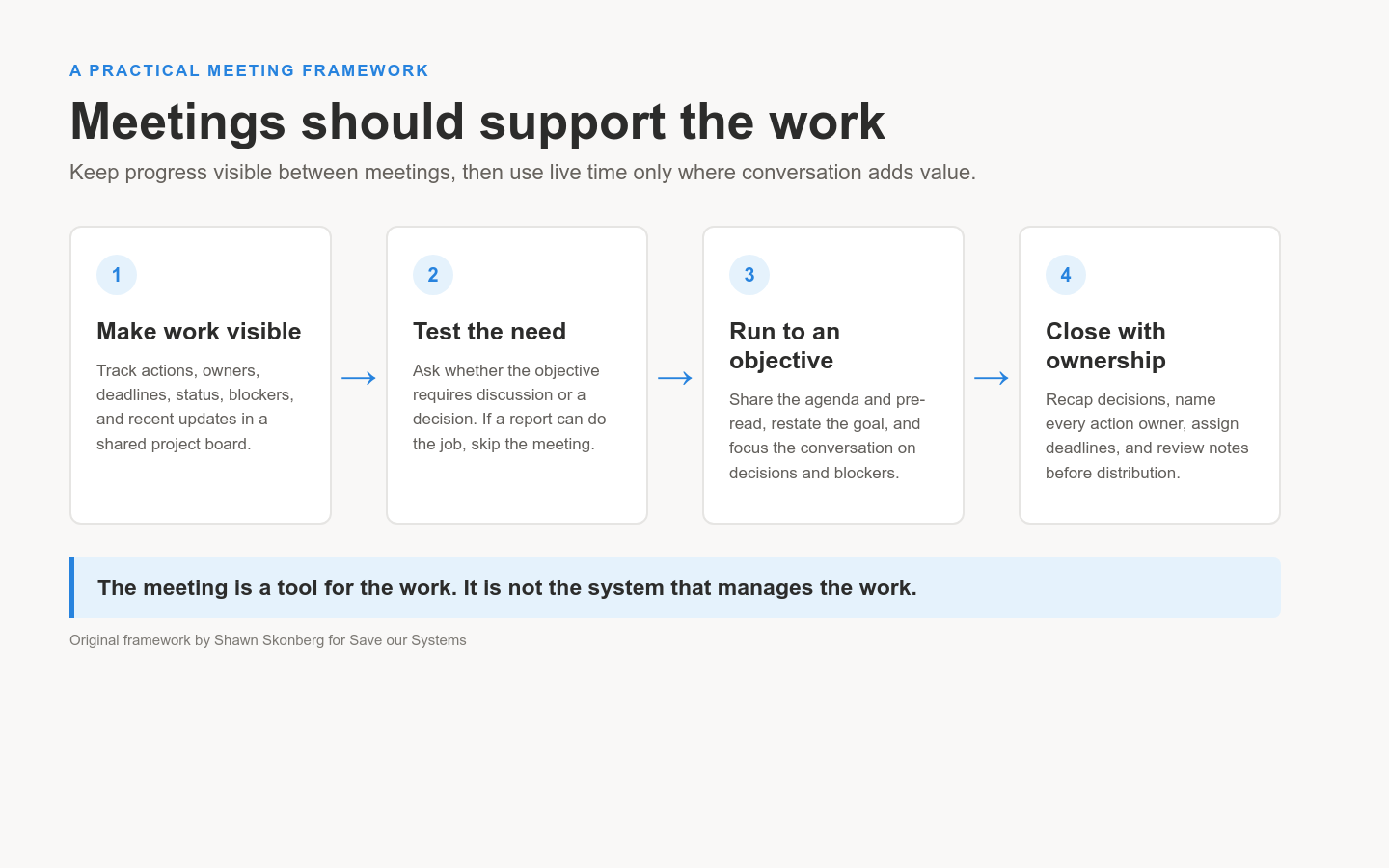
The meeting-support framework: make work visible, test the need for live discussion, run to a stated objective, and close with ownership.
Prepare the Meetings That Remain
When a meeting is justified, preparation should make that clear before anyone joins.
The invitation should state the objective in direct language. “Review the project” is a topic, not an objective. “Decide whether to move the release date based on the current testing risks” tells participants what information to examine and what outcome the group must produce.
Attach the reports, lists, metrics, or background material that participants need. A thoughtful pre-read prevents the meeting from becoming a slow presentation of information everyone could have read independently.
Amazon offers a well-known example. In the company’s 2017 shareholder letter, Jeff Bezos described Amazon’s use of narratively structured six-page memos instead of slide presentations. Participants silently read the memo at the start of the meeting, creating a shared base of information before discussion begins.4
A six-page memorandum would be excessive for many routine meetings, but the underlying principle scales down. Give people the same facts, define the question, and create space to think before asking for opinions.
I also find value in restating the objective at the beginning of the meeting. Even when it appeared in the invitation, saying it aloud helps reset attention. It gives the facilitator a reference point when the conversation drifts: Is this discussion moving us toward the decision we came here to make?
Protect Focus Time Without Creating a Rigid Rule
Meeting-free days can be powerful when they match the work.
A development or engineering team may benefit from protecting Tuesdays and Thursdays for uninterrupted concentration, with collaborative meetings clustered on Monday, Wednesday, and Friday. That rhythm gives people confidence that large sections of the week will not be fragmented by calls.
The same schedule may make little sense for sales or client-success teams whose work depends on speaking with customers. In those environments, managers might need protected planning days even when customer-facing team members do not. Another organization may reserve mornings for focus rather than dedicating entire days.
The principle matters more than the pattern. Focus time should be designed intentionally, not treated as the leftover space between meetings. Leaders also need to model the behavior. A meeting-free day that senior staff routinely violate will quickly become an empty label.
Use AI Meeting Notes as Support, Not Authority
AI meeting notes can help participants listen, ask questions, and engage with the actual conversation instead of trying to produce a transcript by hand. They are particularly useful for capturing a first draft of the discussion and identifying possible action items.
They are still drafts.
Before distributing an AI-generated summary, someone should review names, decisions, deadlines, and ownership. The host should also consider consent, the sensitivity of the discussion, where the recording or transcript will be stored, who can access it, and whether the meeting should be captured at all.
One simple practice improves both human and automated notes: reserve the final few minutes for a verbal recap. State each decision and say who owns every action item, along with the expected date. Invite corrections while everyone is still present. The recap gives the team a shared understanding and gives the AI system clearer language to summarize.
For external meetings, follow with reviewed written notes. The recap should document what was decided, what remains open, who is responsible for each action, and when the parties expect to reconnect. A prompt follow-up can prevent two organizations from leaving the same conversation with different interpretations.
A Meeting Should Create Movement
The action item I rushed to finish before a weekly touchbase taught me something uncomfortable. The meeting was doing work that the project system should have been doing all week. It was creating visibility and urgency only at the last moment.
The answer is not to eliminate every recurring meeting. Some conversations deserve real-time attention, and some relationships benefit from a dependable cadence. The answer is to be mindful of what each meeting is being asked to carry.
Make the work visible between meetings. Question whether a report can replace a call. Give every necessary meeting an objective. End by naming decisions, owners, and deadlines. Protect focus time in a way that fits the people doing the work. Use AI to support memory, but keep human judgment in charge.
When those practices are in place, the weekly meeting no longer has to manage the project. It can do what meetings are actually good at: help people think together, decide together, and move the work forward.
By Shawn Skonberg
Shawn Skonberg writes Save our Systems, exploring systems thinking, technology, leadership, productivity, and AI. This article draws on firsthand experience coordinating technical and operational work across competing priorities.
Sources
- Atlassian, “Workplace Woes: Meetings Edition”, March 20, 2024.
- Leslie A. Perlow, Constance Noonan Hadley, and Eunice Eun, Harvard Business Review, “Stop the Meeting Madness”, July–August 2017.
- Jena McGregor, Forbes, “This Company Is Canceling All Meetings With More Than Two Employees To Free Up Workers’ Time”, January 3, 2023.
- Jeff Bezos, Amazon, 2017 Letter to Shareholders, published 2018.