Why Is My AI Giving Wrong Answers? Fix Your Data First
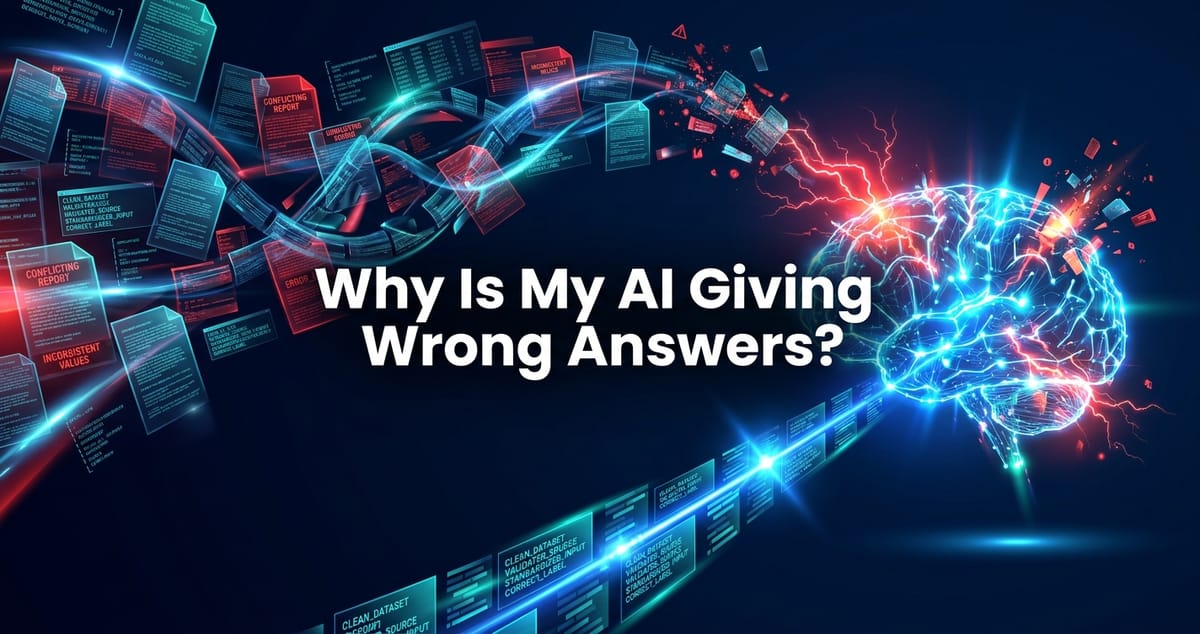
A while back I went looking for something that should have taken two minutes. I needed the details of one of our products and the steps to connect to it, so instead of digging through pages myself I asked our AI assistant. It produced an answer, then quietly contradicted itself. One documentation page listed a set of servers, hostnames, and IP addresses for that system. A newer page listed different ones. The AI could not tell which set was right, so it hedged, and I ended up doing exactly what I had hoped to avoid: tracking down the correct answer by hand.
If you have ever asked yourself why is my AI giving wrong answers, that small moment holds the explanation. The model was not broken. It was doing its best with documentation that disagreed with itself. The problem was never the AI. The problem was the data underneath it.
Why is my AI giving wrong answers? Usually it is the data
When an AI tool hands you a confident but incorrect answer, the instinct is to blame the model and start shopping for a better one. That is usually the wrong fix. AI assistants build their responses from the information they can find in your systems, so when that information is incomplete, outdated, or contradictory, the output inherits every flaw. Garbage in, garbage out never went away. AI just made it faster and far more convincing.
This is the uncomfortable truth behind a lot of stalled AI efforts. The technology is rarely the weakest link. The data feeding it is.
The real bottleneck is documentation, not the model
The research backs this up. BARC's Data, BI and Analytics Trend Monitor 2026, a survey of 1,579 professionals worldwide, ranked data quality as the number one priority for the year, ahead of AI itself [1]. After a decade of chasing the next shiny tool, organizations are circling back to the foundations.
Gartner is blunter. It predicts that through 2026, organizations will abandon 60 percent of AI projects that are not supported by AI-ready data [2]. Not 6 percent. Sixty. And the reason is not the algorithms. It is the messy, ungoverned data sitting beneath them.
I have come to see documentation as the most underrated part of that foundation. Your systems, your procedures, the way your business actually runs: if that knowledge is scattered, conflicting, or trapped in someone's head, no clever prompt will rescue it. A model needs your business context to be useful, and documentation is how that context gets in.
When good companies trust bad data
This is not a small-shop problem. Some of the most expensive failures in recent memory trace back to flawed data rather than flawed ambition.
Zillow shut down its home-buying business in 2021 and laid off about 2,000 people, roughly a quarter of its workforce, after pricing models fed by limited and unreliable data kept overpaying for homes [3]. Unity Software lost around $110 million in revenue and billions in market value in 2022, blaming the ingestion of bad data from a large customer [4]. Equifax sent lenders inaccurate credit scores on millions of consumers because of a data and coding issue [4].
The pattern repeats at the scale of entire AI programs. A study from MIT's Project NANDA found that 95 percent of generative AI pilots delivered no measurable return, with the authors tying the failures to poor integration and data readiness rather than the quality of the models [5]. The companies in that 95 percent did not lack talent or budget. They lacked a foundation.
Models can only work with what they can find
Here is the part that gets overlooked. It is not enough for your data to exist and to be accurate. An AI prompt has to be able to find it.
A perfectly correct document that lives in a folder nobody links to, or sits inside an attachment the system never indexed, might as well not exist as far as your AI is concerned. Making company data searchable is not a nice-to-have. It is the difference between an assistant that answers from your reality and one that fills the gaps with guesses.
This is also where contradictions do the most damage. When two findable pages disagree, the way my two server lists did, the AI has no way to referee. It does not know that the newer page was meant to replace the old one, or that one was a draft someone forgot to delete. It treats both as truth and lands somewhere in between, which is to say wrong.
Documentation debt and the single source of truth
Every team I have worked with carries what I would call documentation debt. It is the pile of half-updated runbooks, duplicate wiki pages, and stale references that accumulate quietly until the day something important depends on them. For years that debt mostly cost human time. Now it directly poisons your AI.
Poor data quality already costs organizations an average of $12.9 million a year, according to Gartner [6]. A 2025 report from the IBM Institute for Business Value found that 43 percent of chief operating officers named data quality as their single most significant data priority, with more than a quarter of organizations estimating losses above $5 million a year from bad data [7]. Those figures predate the moment AI agents began querying the same records at machine speed, and they will only climb.
The antidote is an old idea: a single source of truth. One authoritative place for each fact about how a system works, kept current, with the outdated versions retired rather than left to rot. It is not glamorous work. It is the boring, foundational work that decides whether everything built on top of it holds.
How IT leaders can fix the data problem
If you lead a team and you suspect your AI problem is really a data problem, you do not need a sprawling governance program to begin. You need to clean the foundation on purpose. A few practical moves go a long way:
- Audit for duplicates and contradictions. Find the pages that describe the same system, server, or process, and reconcile them into one.
- Date and version your records. A document with no last-updated date is a trap waiting to mislead both people and AI.
- Retire what is stale. Archiving an outdated page is often worth more than writing a new one, because it pulls a wrong answer out of circulation.
- Name a single source of truth. For each system or process, designate the one authoritative place and point everything else to it.
- Make it findable. Structure and tag documentation so your tools can actually retrieve it, not just store it.
None of this requires a new platform. It requires the discipline to treat documentation as infrastructure, because that is what it has quietly become.
Foundations before flash
I keep returning to that two-minute task that turned into a manual search. The AI did not fail me. My documentation did. Once I saw it that way, the fix stopped being about finding a smarter assistant and started being about cleaning up the mess underneath.
That is the whole argument in miniature. Before you blame the model, look hard at what you are feeding it. The organizations pulling real value from AI are not the ones with the fanciest tools. They are the ones that did the unglamorous work of getting their data and documentation in order first. Foundations before flash.
There is a natural next question buried in here, which is whether you can use AI itself to help clean up that documentation. I have been experimenting with exactly that, and it deserves its own article. For now the takeaway is simpler. If your AI keeps giving wrong answers, do not start by replacing the AI. Start by fixing what it reads.
Sources
- BARC, "Data, BI & Analytics Trend Monitor 2026," 2025. barc.com
- Gartner, "Lack of AI-Ready Data Puts AI Projects at Risk," February 26, 2025. gartner.com
- GeekWire, Todd Bishop and Nat Levy, "Zillow to shutter home buying business and lay off 2,000 employees," November 2, 2021. geekwire.com
- Dataversity, "Understanding the Impact of Bad Data" (Unity Software and Equifax examples). dataversity.net
- Fortune, Sheryl Estrada, "MIT report: 95% of generative AI pilots at companies are failing," August 18, 2025. fortune.com
- Gartner, "Data Quality: Best Practices for Accurate Insights." gartner.com
- IBM, "A compounding threat: The true cost of poor data quality," 2025. ibm.com