Protect Your Team's Focus: A Leadership Imperative
Reclaim Your Team's Focus: Why Protecting Deep Work Is a Leadership Job
Picture one of your best engineers finally settling into a hard problem. The architecture is taking shape in their mind, the variables are lined up, and the path forward is becoming clear. Then a message lands. "Quick question, got a sec?" They answer. It takes ninety seconds. When they turn back to the screen, the structure they had so carefully assembled has collapsed, and they begin the slow climb back to where they were.
That climb is far longer than most managers assume. Research by Gloria Mark at the University of California, Irvine found that after an interruption it takes an average of 23 minutes and 15 seconds to return to the original task [1]. A ninety-second question did not cost ninety seconds. It cost the better part of half an hour, and it stole it from your highest-value work.
This is the quiet tax running through most knowledge teams, and it rarely shows up on a status report. So let me argue something many leaders resist: protecting deep work is not your team's problem to solve through willpower. It is your job.
The cost is real, and it is compounding
The interruption problem is not standing still. It is getting worse. Mark has tracked attention on screens for two decades, and the trend line is stark. Back in 2004, people averaged about two and a half minutes on a single screen before switching. Since around 2016, that figure has fallen to roughly 47 seconds [2]. We are not simply being interrupted by others. We have trained ourselves to fracture our own attention.
The tooling we hand people makes it easy. A Harvard Business Review study of 137 employees across three Fortune 500 companies found that workers toggled between applications and websites nearly 1,200 times per day, spending just under four hours each week reorienting themselves after each switch. Over a year, that adds up to about five working weeks, or roughly 9 percent of their time at work [3]. That is not a rounding error. That is a full sprint's worth of capacity lost to friction that leaders, not individual contributors, designed into the day.
The most important insight from that research is easy to miss. The authors concluded that this fragmentation is usually not the unavoidable cost of digital work. It is an active choice that companies and managers make about how work gets done. If it is a choice, it can be unmade.
We reward the new over the important
Why do teams tolerate this? Because we have quietly confused availability with value. The new message feels urgent. The unfinished design document does not ping. So we answer the new and defer the important, day after day, and we mistake the resulting motion for progress.
This is the cultural trap at the heart of the problem. When responsiveness becomes the measure of a good employee, the people who protect their focus look like the people who are not pulling their weight. The engineer heads-down on the hard problem appears less engaged than the colleague firing off replies in every channel. We end up rewarding the very behavior that erodes our most valuable output.
Leaders set that incentive, whether they mean to or not. If you reward the fastest responder, you will get a team of fast responders and very little deep work.
Focus is a leadership responsibility
Here is the reframe. Your individual contributors cannot fix this alone, because most of their interruptions do not originate with them. They come from other teams, other managers, urgent escalations, and a culture that expects an instant reply. Telling someone to simply ignore their notifications while the organization still demands availability is setting them up to fail.
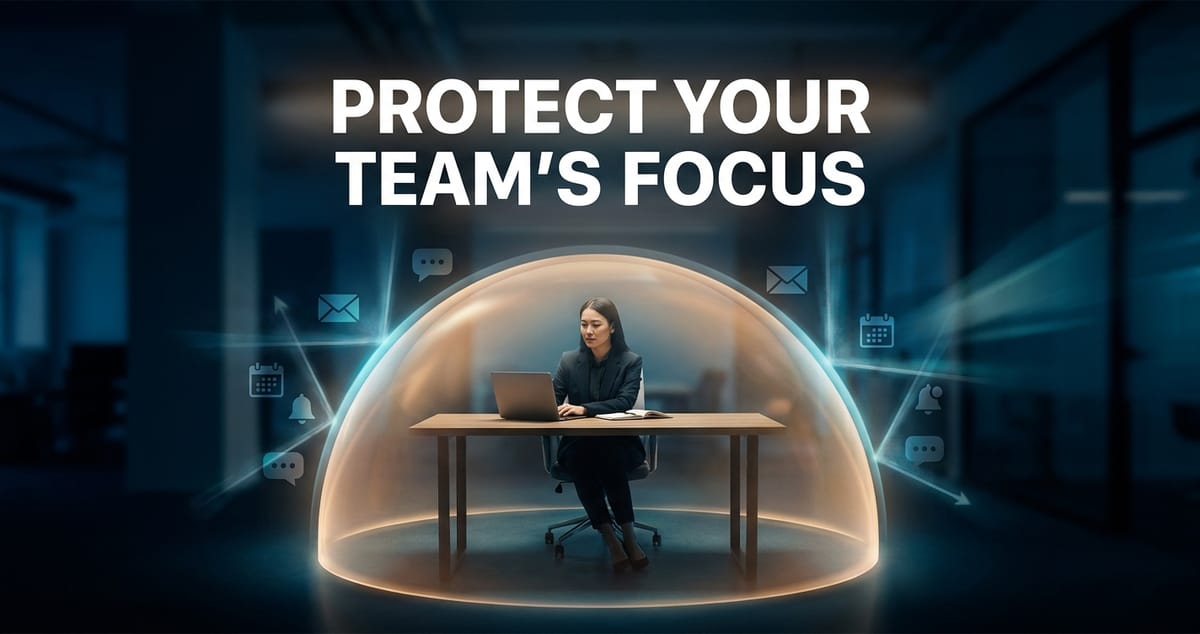
The leader sits in the one position that can actually resolve the tension. Your job runs in two directions at once. Upward and outward, you stay available to other departments, peers, and leaders, because that responsiveness is genuinely part of the role. Downward, you shield your team from the constant pull so they can do the work you hired them to do. You absorb the interruption so they do not have to.
Think of it as a one-way valve. Questions and context flow up to you. Protected time flows down to them. A leader who instead passes every interruption straight through to the team is not managing. They are just forwarding noise.
Build an interrupt rotation
The most practical way to operationalize this is an interrupt rotation. Rather than letting every question hit every person at random, you designate one team member as the day's interrupt handler. That person fields the incoming questions, triages the escalations, monitors the busy channels, and handles the shallow work that would otherwise shatter everyone else's concentration. The rest of the team goes heads-down, genuinely protected.
The key is that this is planned in advance, not improvised. You build the rotation into the schedule, and you adjust workloads accordingly. The person on interrupt duty carries a lighter load of deep work that day because their real job is to be the shield. Everyone takes a turn, so no one carries the burden permanently, and everyone gets stretches of uninterrupted time they can count on.
This small structural change does something willpower never can. It makes deep work the default rather than the exception, and it gives the team a shared, fair system instead of a private struggle each person fights alone.
A system, not a single tool
There is no single app that fixes this, and chasing one misses the point. What works is a system of habits and tools tuned to how your team actually operates. During a protected block, the rules are simple and explicit: close email, close chat, silence notifications on both work and personal devices, and post a clear status that says you are in deep work and will respond afterward. The status message matters more than it sounds, because it gives people permission to be unavailable and tells everyone else what to expect.
Structure the time, too. The Draugiem Group, analyzing data from the productivity tool DeskTime, found that the most productive 10 percent of users worked in focused bursts of about 52 minutes followed by roughly 17-minute breaks [4]. The exact numbers matter less than the principle: sustained focus followed by real recovery beats a day of shallow, scattered presence. Whatever cadence your team adopts, the goal is the same, which is to make uninterrupted stretches normal and to make recovery deliberate.
This is not just a software problem
Engineers feel this acutely because getting into flow as a developer takes time, often fifteen to twenty minutes of ramp-up before you are fully enveloped in the problem. Interrupt that climb and you do not lose a minute, you lose the whole ascent and have to start over. That is why a fragmented day can erase most of an engineer's productive capacity even when they never stopped working.
But the principle generalizes well beyond software. Consider an auto mechanic. You want your skilled mechanics turning wrenches on the cars in the bay, working through diagnostics without breaking concentration. You do not want them pulled to the front counter every few minutes to answer customer questions. The shop that staffs a service advisor to handle customers, so the mechanics can stay on the work, is running an interrupt rotation without calling it one. Any role that depends on sustained concentration and skilled output faces the same math.
But not every interruption is the enemy
It would be a mistake to treat all interruptions as evil. A genuine emergency, a customer escalation that cannot wait, or a teammate truly blocked and unable to move forward are all worth the cost of breaking focus. The aim is not a fortress that nothing can penetrate. It is a filter that lets the truly urgent through and holds back everything else until the focus block ends. The interrupt rotation is exactly that filter, because it gives every real question a clear destination while sparing the rest of the team.
A leader's checklist
If you take one thing from this, make it the recognition that your team's focus is yours to defend. A few concrete moves put that into practice:
- Protect focus blocks on the calendar and treat them as real commitments, not the first thing to be sacrificed.
- Run a planned interrupt rotation so one person shields the rest, with workloads balanced to match.
- Model the behavior yourself by not pinging the team during their deep work, and by holding your own non-urgent questions until the block ends.
- Judge output over responsiveness, and say so out loud, so the team knows that heads-down work is what you actually value.
The engineer at the start of this piece did not need more discipline. They needed a manager willing to stand between them and the noise. Attention spans are shrinking and the interruptions are multiplying, but the levers that protect focus still sit squarely in a leader's hands. The teams that pull those levers will quietly outproduce the ones that keep rewarding the new over the important. The question is not whether your people can focus. It is whether you will let them.
Sources
- Gloria Mark, Daniela Gudith, and Ulrich Klocke, "The Cost of Interrupted Work: More Speed and Stress," Proceedings of the SIGCHI Conference on Human Factors in Computing Systems, 2008. https://ics.uci.edu/~gmark/chi08-mark.pdf
- Steelcase, "Our 47-Second Attention Span With Gloria Mark (S5: EP3) Transcript," 2023. https://www.steelcase.com/research/articles/our-47-second-attention-span-with-gloria-mark-s5-ep3-transcript/
- Rohan Narayana Murty et al., "How Much Time and Energy Do We Waste Toggling Between Applications?" Harvard Business Review, August 2022. https://hbr.org/2022/08/how-much-time-and-energy-do-we-waste-toggling-between-applications
- DeskTime, "Does the 52-17 rule really hold up?" (Draugiem Group productivity study). https://desktime.com/blog/52-17-updated/