How to Create a Safe Environment for Disagreement at Work
A few years into the work I do untangling problems that cross company lines, I found myself on a call with people from three different organizations, all of us staring at the same failure and none of us sure what caused it. Those calls have a gravitational pull toward blame. When a system is down and the clock is running, the easy instinct is to defend your own organization and start looking for someone else's mistake. I have learned that the better instinct is the uncomfortable one: say plainly that you do not yet know, and invite the people who might disagree with you to say so.
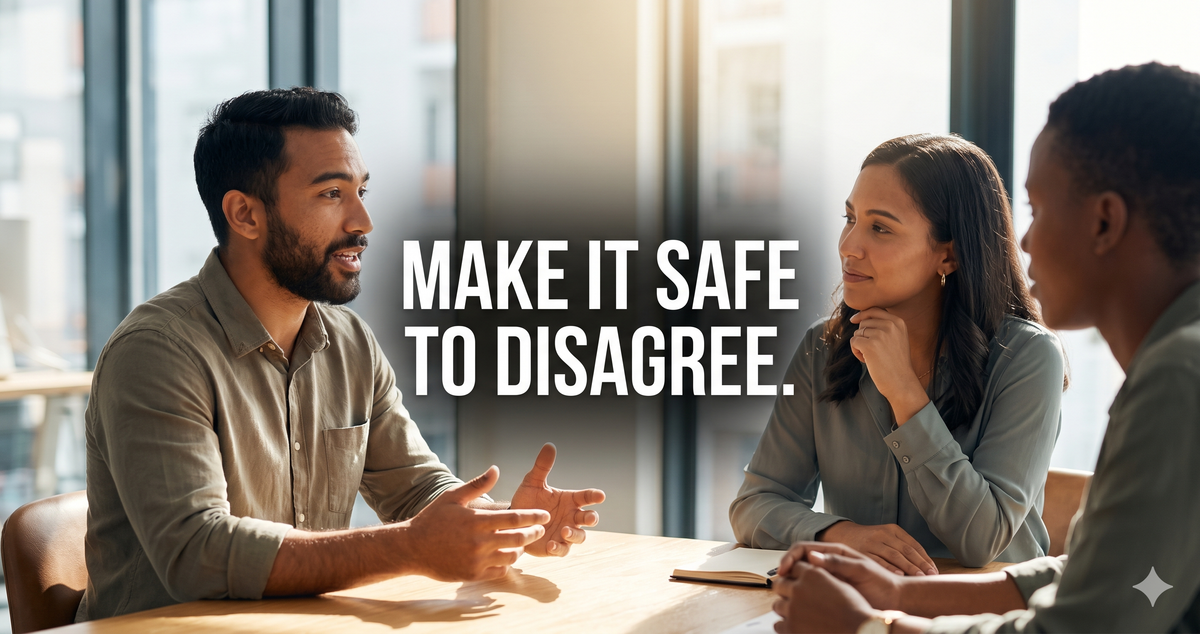
That habit, inviting the disagreement instead of bracing against it, is the whole game. A safe environment for disagreement at work is not a soft perk or a nice-to-have. It is the mechanism that catches errors before they ship and turns a group of cautious individuals into a team that actually thinks together.
Hard problems have more than one right answer
Start with a truth that anyone in a technical field learns quickly. Most real problems have several defensible solutions, and the gap between a good decision and a costly one often comes down to whether someone felt free to say "I think we are wrong about this." When you shut that voice down, you are not keeping the peace. You are quietly choosing a worse answer.
The most cited evidence for this comes from Google. Over two years the company studied 180 of its teams, expecting to find that the best ones were stacked with the strongest individual performers. Instead, the single factor that separated high-performing teams from the rest was psychological safety, the shared sense that you can take an interpersonal risk without being punished for it [1] [2]. Harvard's Amy Edmondson, who introduced the term in 1999, defines it as a shared belief that the team is safe for that kind of risk taking [3]. In plain language, people do their best thinking when they are not afraid of looking foolish.
What a quiet room actually costs
A team that has gone silent looks calm from the outside. Meetings end on time. Nobody argues. The danger is that silence and agreement look identical right up until something breaks.
The clearest cautionary tales come from NASA. Reviews of both the Challenger and Columbia shuttle losses found engineers who held real concerns and a culture that, in different ways, suppressed dissent and discouraged anyone from forcing a harder conversation before launch [4]. Most of us will never make a decision with those stakes. The pattern still rhymes with ordinary work, where a junior analyst notices something off, reads the room, and decides it is not worth the discomfort of speaking up. The cost is not dramatic. It is a slow accumulation of small, unspoken corrections that never get made.
The fastest way to silence a team
If you want to teach a team to stop talking, there is a reliable method. Walk into a meeting with the decision already made and ram it through. Treat the discussion as a formality. Do that once or twice and people learn the lesson you are actually teaching, which is that their input is decoration.
The damage often starts at the top of the room. A meeting usually holds a mix of individual contributors, middle managers, and senior leaders, and each of them sees the problem from an angle the others cannot. A leader who spends the whole hour on a pedestal, more interested in being right than in being corrected, wastes every one of those vantage points. Ego is the tax that quiet rooms pay.
Here is the part that gives me hope. The same behavior that breaks trust can begin to rebuild it. When a manager rams a decision through and then later names it, acknowledges that they cut off the conversation and should not have, that admission does real work. It tells the team that the standard applies to the person in charge too. People forgive the misstep far more readily than they forgive the pretense that no misstep happened.
Humility is a discipline, not a mood
The leaders who get this right do something subtle. They deliberately put themselves in a position to be disagreed with. They make statements that invite correction rather than statements that close the door. "Here is where I am leaning, and I want to know what I am missing" is an entirely different prompt than "Here is the plan." One opens a conversation. The other ends it.
This is also where a common misreading needs correcting. Psychological safety is not about everyone feeling good or lowering the bar. Edmondson herself is blunt that it does not mean freedom to do your job poorly. It means freedom to speak without fear of humiliation while still being held to a high standard [5]. Safety and accountability are partners, not opposites. Amazon built a version of this into its leadership principles with "Have Backbone; Disagree and Commit," which obligates leaders to challenge a decision they think is wrong, then commit fully once the call is made [6]. The disagreement is required. So is the commitment that follows it.
A few moves make this practical:
- Ask for the strongest argument against your own proposal before you close a decision, and mean it.
- Respond to the first person who pushes back with curiosity rather than defense, because everyone else is watching how that goes.
- Separate the work from the person, so a challenge to an idea never reads as an attack on the colleague who raised it.
When the room is a screen
All of this is harder through a webcam, and harder still on an audio-only call. Disagreement is a delicate act that leans heavily on tone, expression, and the small nonverbal cues that tell you whether a comment landed as curiosity or as criticism. Strip those away, and a mild question can read as a cold one. Silence on a muted line gives you nothing to work with.
I have watched good points die on calls simply because the speaker could not read the room and assumed the worst. The fix is to be more deliberate than you would be in person. Turn cameras on when you can. Go around the group by name instead of waiting for volunteers, since the quiet seat is even quieter online. Ask directly for the counterargument so dissent has a sanctioned door to walk through. When something important gets decided on a call, follow up in writing so anyone who hesitated in the moment has a second chance to push back.
The standard worth holding
That call with three organizations resolved eventually, but not because anyone won the argument. It resolved because enough people in the room were willing to stay in the discomfort of not knowing, float competing theories, and let the weak ones fall away. Nobody had to be protected from blame because nobody was rushing to assign it.
That is the standard I keep coming back to. Invite the disagreement, especially when you are the most senior voice in the room. Protect the people while you stress-test their ideas. Resist the pull to point fingers in any direction, including your own, before you actually understand what happened. A team that can disagree well is not a team in conflict. It is a team that has decided the truth matters more than anyone's ego, and that decision, made over and over in small moments, is what keeps the whole system standing.
Sources
- Google re:Work, "Understand team effectiveness." rework.withgoogle.com
- The New York Times Magazine, Charles Duhigg, "What Google Learned From Its Quest to Build the Perfect Team," February 2016. nytimes.com
- Harvard Business School Working Knowledge, "Four Steps to Building the Psychological Safety That High-Performing Teams Need." library.hbs.edu
- Forbes, Bryce Hoffman, "Why The Challenger Disaster Still Matters To Business Leaders Today," January 2026. forbes.com
- NeuroLeadership Institute, "Psychological Safety and Accountability: Three Insights From NLI's Conversation With Amy Edmondson." neuroleadership.com
- Amazon, "Leadership Principles: Have Backbone; Disagree and Commit." amazon.jobs