Discuss my weekly review
My Weekly Review Ritual
Every Sunday, before the week has a chance to ambush me, I sit down for about 30 minutes and run through a ritual that has quietly become the most important productivity habit I have. It is not glamorous. It is not complicated. But it is the single reason I start most Mondays feeling calm, focused, and genuinely ready.
This is my weekly review.
The concept is inspired by David Allen's Getting Things Done methodology and shaped by Tiago Forte's approach to building a "Second Brain." But over time I have adapted it into something personal: a 13-step checklist that I treat less like a chore and more like a reset button for my entire week. If you have ever reached Friday wondering where the time went, or opened your laptop on Monday morning with no idea what to work on first, this process is built to fix that.
What Is a Weekly Review (and Why Does It Work)?
A weekly review is a recurring check-in where you step back from the day-to-day noise, process everything that accumulated during the week, and deliberately choose what matters most for the week ahead.
The reason it works is straightforward. Without it, your task list drifts out of sync with reality. Commitments pile up unnoticed. Small things slip through cracks and become big problems. A weekly review catches all of that before it compounds.
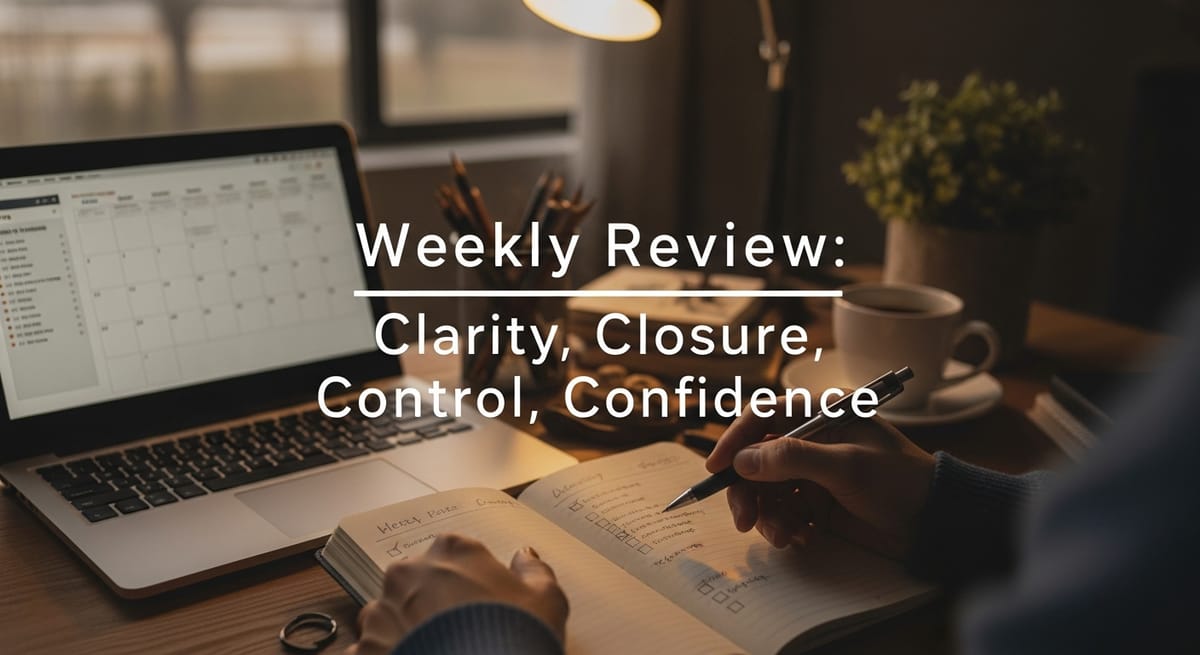
The outcomes I aim for every Sunday are simple:
- Clarity: I know exactly what I am committed to this week.
- Closure: Loose ends are captured, clarified, or deleted.
- Control: My calendar and task lists reflect what is actually happening.
- Confidence: I trust my system enough to stop worrying and start focusing.
Tiago Forte frames the weekly review as a quick check-in to clear workspaces, update tasks, and choose weekly priorities, rather than a deep overhaul of your goals. I agree. The moment a weekly review starts feeling like a life audit, it stops being sustainable. The key is keeping it lightweight and repeatable.
The Three Phases: Clear, Review, Reboot
My 13 steps follow a structure borrowed from GTD's three-stage loop: Get Clear, Get Current, and Get Creative. I think of them as three phases that build on each other. You clear the noise first, then review reality, then prepare the machine for what is next.
Phase 1: Clear and Reset
The first phase is about eliminating friction. Before I can think clearly about priorities, I need to empty every input channel that collected stuff during the week. This is David Allen's core insight: your system must be trusted, and trust comes from nothing slipping through the cracks.
Here is what I clear every Sunday:
- Clear Physical Inbox. I process any paper, mail, sticky notes, or physical items that piled up. Capture tasks, file reference material, toss the rest.
- Clear Desktop. I tidy my computer desktop by filing or deleting screenshots, temp files, and anything that creates visual noise. A cluttered desktop is a constant low-grade distraction.
- Clear Downloads Folder. This folder accumulates fast. I file what I need and delete everything else.
- Clear Scanned Folder. Any scanned receipts, signed forms, or reference documents get routed to their proper digital home.
- Clear your app inboxes. Any application you use on a regular basis that has an inbox or capture queue needs to hit zero. For me, that means Notion, where my automations and quick captures land throughout the week: clipped articles, saved links, quick notes. For you, it might be a project management tool, a read-later app, a notes app, or anything else that collects items passively. The goal is the same for all of them: go through each item and ask, is this actionable? Is it reference material? Can it be deleted? Get to zero.
By the end of this phase, every input channel is at zero. My physical and digital workspaces are clean. I can think without background noise.
Phase 2: Review and Reflect
With a clean slate, I move into the review itself. This is where the real planning happens.
- Review Calendar. This is one of the two most important steps in my entire review, and I do it differently than most guides suggest. I look back at last week's calendar to catch anything that fell through the cracks: follow-ups I forgot, commitments I made in meetings, notes I never processed. Then I look ahead. Not one week. Not two. Three full weeks.
Most weekly review advice tells you to glance at the upcoming week. Some stretch to two. But I have found that three weeks is the sweet spot where you start catching the things that really matter: a major presentation in 18 days that needs research time blocked now, a project milestone whose dependencies you need to chase today, a personal commitment that will shrink your available work time and requires front-loading tasks this week.
This idea has strong roots outside of personal productivity. In construction project management, the "three-week lookahead" is an industry-standard practice. Teams discovered that a one-week horizon only catches what is already urgent, while a three-week window catches dependencies, resource conflicts, and preparation needs before they become emergencies. The same logic applies to your personal calendar. When you review three weeks ahead every Sunday, you are not just planning this week. You are shaping the next three.
- Review Current Projects. I walk through every active project and ask three questions: Does it still have a clear next action? Is it actually moving forward? Am I still committed to it? If a project is stalled with no realistic next action and no urgency, it might belong somewhere else.
- Someday/Maybe Projects. This is the other step I consider essential, and it is one of the most misunderstood concepts in productivity.
A someday/maybe list is not a to-do list. It is a curated holding pen for ideas, aspirations, and potential projects that you are not committed to right now but do not want to lose. David Allen calls it one of the most powerful tools in the GTD system because it solves two problems at once: it prevents you from trying to keep everything active (which leads to overwhelm and guilt), and it stops good ideas from vanishing because there was no place to put them.
Think of it as a guilt-free parking lot. Items on it are options, not obligations. "Learn woodworking." "Start a podcast." "Build a home automation system." These are all valid someday/maybe entries.
During the weekly review, I scan this list and ask two questions. First: should anything here become active? Maybe circumstances changed and I now have the time, budget, or motivation to pull something forward. Second: should anything be deleted? If an idea no longer excites me, I remove it. The list should feel energizing, not like a graveyard of abandoned dreams.
I also check the reverse direction. Are any of my active projects actually stalled? If so, moving them to someday/maybe is not failure. It is an honest acknowledgment of current capacity.
Tiago Forte reinforces this with his concept of "intermediate packets": you can capture and organize material for a someday/maybe project now, even if you will not act on it for months. When you do activate it, the groundwork is already laid.
- Review Waiting For. I check items I am waiting on from other people. Follow up on anything overdue. This is one of the most commonly skipped steps in any review process, and also one of the most valuable. It prevents things from silently stalling because you assumed someone else was handling it.
- Review Blocked Tasks. I identify tasks that are stuck and figure out what needs to happen to unblock them. Can I take a different approach? Do I need to escalate? Should the task be deferred until conditions change?
- Complete Retrospectives. I reflect briefly on what went well, what did not, and what I would change. This is the feedback loop that makes each subsequent week better than the last. The book Personal Kanban emphasizes retrospectives as the mechanism by which you learn from your own workflow patterns. Without reflection, you repeat the same mistakes. With it, you compound improvement.
Phase 3: Maintain the Machine
Reboot your electronics. Every device you use on a daily basis gets a restart: laptops, phones, tablets, whatever is in your rotation. No matter how good your hardware is, electronics accumulate background processes, memory leaks, and minor software glitches over time. A weekly reboot clears all of that, applies pending updates, and resets system state. It is the digital equivalent of clearing your desk.
This step might seem trivial compared to reviewing projects and scanning calendars. But it embodies an important principle: your tools should be in ready-state when the week begins. The weekly review is not just about tasks and projects. It is about ensuring your entire environment supports focused work.
Why Sunday (and Why It Sticks)
I do my weekly review every Sunday, and the timing is deliberate.
Sunday creates a clean psychological boundary between the week that ended and the week ahead. You process what happened (closure) and decide what will happen (intention). Without this transition, Monday morning starts with the cognitive load of figuring out where you left off and what matters most, all under time pressure.
Sunday is also typically lower-pressure than a weekday morning. You have more cognitive bandwidth to make good decisions about priorities. Research on decision fatigue suggests that the quality of choices degrades as the number of prior decisions in a day increases. By reviewing on Sunday, before the week's barrage of decisions begins, you are making your most important planning choices with a fresh mind.
There is a practical advantage too. A Sunday review gives you a full evening and a Monday morning to prepare for anything the review surfaced. If you discover a Tuesday meeting that needs a deliverable, you have Monday to handle it. A Friday review often leads to anxiety over a weekend you cannot act on. A Monday review eats into your most productive morning.
Finally, consistency matters. Habits research, from James Clear's Atomic Habits to BJ Fogg's Tiny Habits, shows that anchoring a behavior to a consistent time and context dramatically increases adherence. "Every Sunday after morning coffee" is a cue. "Sometime this weekend when I get around to it" is not.
The Logic of the Sequence
The ordering of these 13 steps is not arbitrary. You clear inputs first because unprocessed items create anxiety and incomplete thinking. You review and reflect second because you need a clear head and complete information to make good decisions. You maintain the machine last because it is a simple, satisfying close to the ritual: a physical action that signals the review is done and the week is ready.
The book Winning the Week calls this a "shutdown ritual": a defined sequence that tells your brain planning is complete and you can relax into the rest of your Sunday.
Common Mistakes to Avoid
After years of doing this, I have identified a few patterns that tend to derail weekly reviews:
- Making it too big. If your review takes more than 60 minutes, you will eventually stop doing it. Forte explicitly warns against turning the weekly review into a life overhaul. Keep it to 30 minutes. Make it repeatable.
- Reviewing tasks but not time. If you only look at your to-do list and skip the calendar, you will miss the reality of what your week actually looks like. Always review both.
- Capturing but not clarifying. It is not enough to dump items into a list. Every captured item should be turned into a clear next action or filed as reference. Fuzzy tasks create procrastination.
- Planning an ideal week with no buffer. Leave slack for interruptions, unexpected tasks, and the simple fact that things always take longer than you think.
Start This Sunday
You do not need a perfect system to start. You do not need special software. You need 30 minutes, a quiet spot, and a willingness to look honestly at where your time and attention are going.
Start with the basics: clear your inboxes, review your calendar three weeks out, scan your projects, and check on anything you are waiting for. That alone will put you ahead of most people who start their weeks blind.
Over time, you will refine the process. You will add steps that matter to you and drop ones that do not. The weekly review is not a rigid prescription. It is a framework. The only rule that matters is this: do it every week, and keep it short enough that you actually will.
The compound effect is real. Each week you review, your system gets a little more trustworthy. Your decisions get a little sharper. And Monday morning, instead of scrambling, you simply begin.
The weekly review is just one layer of the system. I am also planning articles on my monthly review and quarterly review processes, which zoom out further to address longer-term goals, project health, and bigger-picture course corrections. Stay tuned.
Sources
- Tiago Forte, "The One-Touch Guide to Doing a Weekly Review." Forte Labs.
- Todoist, "The Weekly Review: A Productivity Ritual to Get More Done."
- Full Focus (Michael Hyatt), "The Importance of the Weekly Review."
- Hoylu, "Three Week Lookahead."
- Outbuild, "Look-Ahead Schedule: A Comprehensive Guide."
- CrewCost, "Construction Contractor's Guide to Look-Ahead Schedules."
- Art of Manliness, "Your Weekly Plan."