ADHD Meets AI: The Perfect Creative Partnership
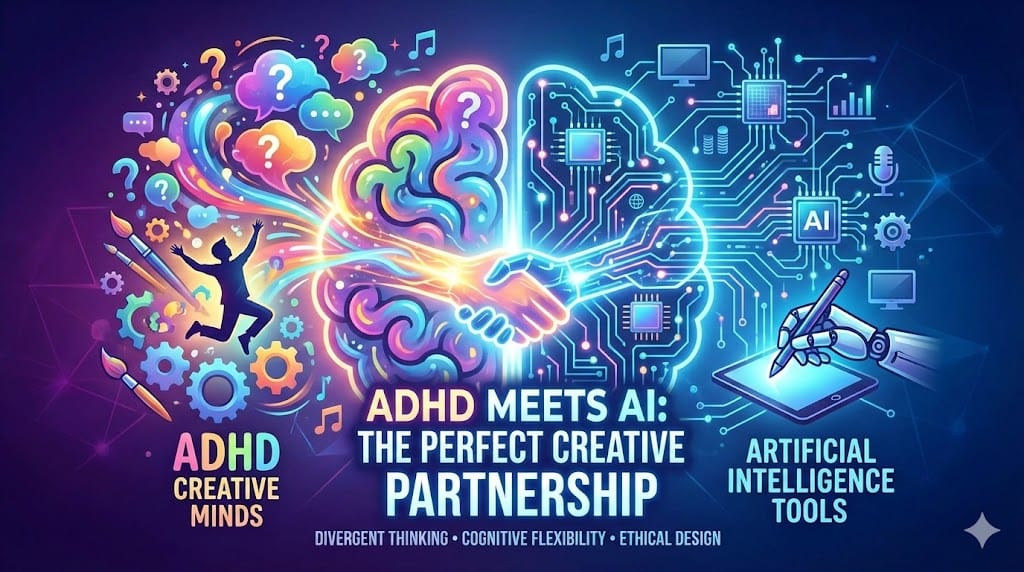
In a world where attention is increasingly fragmented, those with Attention Deficit Hyperactivity Disorder (ADHD) have long been viewed through a deficit lens. But what if the characteristics that define ADHD—divergent thinking, cognitive flexibility, and rapid idea generation—are actually valuable assets in our AI-driven future? Emerging research suggests that the ADHD mind and artificial intelligence may form an unexpectedly powerful partnership, transforming traditional weaknesses into unique strengths.
The Cognitive Advantages of ADHD in the AI Era
People with ADHD often possess several cognitive characteristics that prove advantageous when working with AI tools and technologies. These natural tendencies, once considered limitations in traditional work environments, are increasingly recognized as valuable assets in creative, technology-driven fields.
Divergent Thinking: The Brainstorming Powerhouse
Research by Boot and colleagues (2020) found that individuals with ADHD demonstrate enhanced divergent thinking—the ability to generate multiple solutions or ideas quickly—particularly when intrinsically motivated. This capacity aligns perfectly with AI brainstorming capabilities, creating a synergistic relationship where the human mind generates innovative concepts while AI helps organize and expand upon them.
"Adults with ADHD showed higher levels of creative achievement and creative thinking compared to non-ADHD adults, particularly in divergent thinking tasks," note White and Shah (2011) in their research on creativity and ADHD. This ability to produce numerous unique ideas provides rich source material for AI systems to process, refine, and develop.
Cognitive Flexibility: Adapting to New Possibilities
Studies by Sedgwick and colleagues (2019) suggest that individuals with ADHD often excel at shifting between different conceptual frameworks—an ability that facilitates creative applications of AI outputs and adaptation to new AI capabilities. This cognitive agility allows for exploring diverse applications of AI-generated content and identifying unconventional use cases that might elude more linear thinkers.
The Hyperfocus Advantage
While difficulties with attention regulation are a hallmark of ADHD, many individuals also experience hyperfocus—the ability to become deeply engaged in stimulating tasks. Hupfeld and colleagues (2018) note that this capacity may enhance learning complex AI systems and sustain engagement with challenging AI projects. When working with engaging AI tools, this intense concentration can lead to extended periods of productivity and deep learning.
Pattern Recognition Beyond the Obvious
Some research suggests that individuals with ADHD may have enhanced abilities to identify patterns and connections that others miss. According to Armstrong (2010), this "hunter" mindset can be particularly valuable when identifying useful patterns in AI-generated content or making unexpected connections between AI outputs and potential applications.
How AI Serves as Cognitive Scaffolding
Artificial intelligence systems can provide important support for individuals with ADHD by augmenting executive functions while accommodating natural thinking styles. The relationship is bidirectional: AI supports areas of challenge while the ADHD mind contributes creativity and innovative thinking.
Reducing Cognitive Load Without Reducing Creativity
AI systems excel at automating routine tasks and information management, freeing up cognitive resources for higher-level thinking. A study by Torous and colleagues (2020) demonstrated that digital assistants reduced perceived cognitive burden in individuals with executive function challenges. By handling organizational aspects like sorting information, scheduling reminders, and maintaining records, AI allows the ADHD mind to focus on creative and conceptual work.
Providing Flexible Structure
Unlike rigid organizational systems, AI can offer adaptive frameworks that accommodate non-linear thinking while still providing necessary structure. This balance is particularly important for ADHD minds that often resist overly rigid systems, as noted by Barkley (2012) in his work on executive functions. AI tools can adapt to individual thinking styles rather than forcing users to conform to predetermined workflows.
Enabling Rapid Idea Exploration
The capabilities of generative AI allow for quick exploration and iteration of concepts—a process that aligns well with the preference for rapid ideation often seen in ADHD. This creates what Anthes (2022) describes as a "creative accelerator effect" where AI amplifies natural creative tendencies by quickly generating variations, examples, and extensions of initial ideas.
Maintaining Focus Through Engagement
Through timely prompts, reminders, and engaging interfaces, AI tools can help manage attention without the rigidity of traditional productivity systems. Research by Caye and colleagues (2019) suggests that digital interventions with appropriate engagement mechanisms show promise for attention management. The interactive nature of many AI tools provides immediate feedback that helps maintain interest and focus.
Practical Applications: Where ADHD and AI Shine Together
Several specific applications showcase the potential synergy between ADHD cognition and artificial intelligence technologies.
Content Creation and Creative Work
AI tools can help transform the rapid ideation characteristic of ADHD into structured content, with AI handling organization while the individual focuses on creative aspects. This partnership leverages what White and Shah (2006) identified as enhanced originality in ideation among ADHD adults. Writers, designers, and other creatives with ADHD can use AI to help structure their abundant ideas while maintaining their unique creative voice.
Research and Learning Exploration
AI can support non-linear exploration of topics—following connections and tangents that often characterize ADHD learning patterns—while helping to synthesize findings into coherent knowledge structures. This approach aligns with what Armstrong (2010) describes as the natural "explorer" mindset associated with ADHD. Learning becomes less about following a predetermined path and more about pursuing connections that spark curiosity, with AI helping to organize the resulting knowledge.
Project Management That Works With Natural Tendencies
AI systems can maintain organization and track progress while allowing for the flexible workflows often preferred by those with ADHD. According to a review by Biederman and colleagues (2018), accommodating natural work styles while providing appropriate structure leads to better outcomes than forcing neurotypical work patterns. Rather than requiring rigid adherence to traditional project management approaches, AI can adapt to individual work styles while still ensuring projects move forward.
Creative Problem-Solving for Complex Challenges
The combination of ADHD-driven divergent thinking with AI's capacity to evaluate and refine multiple solution paths may produce particularly innovative outcomes. Kaufman and Sternberg (2019) note that the most creative solutions often emerge from this kind of complementary cognition. For complex problems requiring novel approaches, this partnership can generate solutions that neither human nor AI would likely develop independently.
Documentation and Information Management
"Having a system to capture all of the information you gather will help in the future to work with AI," notes a practitioner with ADHD. "Having a complete documentation system in place will allow recall of that information utilizing AI will be super powerful going forward." This observation highlights how AI can help transform the often scattered information-gathering tendencies of ADHD into valuable knowledge systems.
Addressing Challenges and Ethical Considerations
Despite the potential benefits, several challenges must be addressed to ensure that AI truly serves as a helpful partner rather than creating new problems.
Avoiding Distraction Potential
Without careful design, AI interfaces could exacerbate distractibility. Research by Jachimowicz and colleagues (2019) demonstrates that technology interfaces not designed with attention management in mind can worsen attentional symptoms. AI systems for ADHD users should be designed to minimize unnecessary notifications, visual clutter, and attention-grabbing elements that aren't essential to the task at hand.
Balancing Support Without Creating Dependence
There's a concern that excessive dependence on AI systems might prevent the development of important executive function skills. As noted by Caye and colleagues (2019), technology should supplement, not replace, cognitive skill development. The ideal relationship involves AI supporting areas of difficulty while still allowing for skill building and autonomy.
Protecting Privacy While Enabling Personalization
The data collection necessary for personalized AI assistance raises particular privacy issues for vulnerable populations, including those with ADHD, according to a review by Martinez-Martin and Kreitmair (2018). Users should maintain control over what information is shared and how it's used, with transparent policies about data collection and storage.
Designing for Neurodiversity
Standard AI systems may not adequately account for neurodivergent thinking patterns. Research by Whiteford and colleagues (2021) indicates that many digital tools are designed with neurotypical users in mind, potentially creating barriers for ADHD users. Involving individuals with ADHD in the design process can help ensure that AI tools accommodate different cognitive styles.
Best Practices for Designing AI Tools for ADHD Users
To maximize benefits for people with ADHD, AI systems should incorporate specific design principles that accommodate and enhance their natural cognitive style.
Customizable Interfaces for Individual Needs
Research by Friedman and Bryan (2021) demonstrates that allowing users to adjust stimulation levels and information presentation significantly improves usability for ADHD users. Customizable interfaces that allow for controlling visual complexity, notification frequency, and interaction style can help users create an environment that works with their specific attention patterns.
Clear Feedback Mechanisms
Immediate, meaningful responses to actions help maintain engagement and reduce uncertainty—particularly important for those with ADHD according to studies by Barkley (2012) on executive function support. AI systems should provide clear confirmation when tasks are completed and offer guidance when user input is needed.
Supporting Both Linear and Non-Linear Approaches
Tools allowing for both structured and unstructured organization were most effective for ADHD users in studies by Sedgwick and colleagues (2019). AI systems should support multiple ways of organizing information, allowing users to switch between hierarchical, associative, and chronological views based on current needs and thinking patterns.
Leveraging Strengths Rather Than "Fixing" Differences
Systems that leverage ADHD-related abilities rather than attempting to "normalize" cognitive patterns show better adoption and outcomes according to Armstrong's (2010) work on neurodiversity. The goal should not be to make those with ADHD work like neurotypical individuals, but to enhance their natural strengths while providing support for challenges.
Conclusion: The Future of Neurodivergent-AI Collaboration
As artificial intelligence continues to evolve, its relationship with different cognitive styles will become increasingly important. For individuals with ADHD, AI represents not just a tool but a potential cognitive partner that complements their natural thinking patterns while providing support for executive function challenges.
The ideal future isn't one where AI "fixes" ADHD, but rather one where the unique cognitive profile associated with ADHD is recognized as valuable, with AI serving to enhance these natural strengths while providing structure where needed. This partnership approach represents a shift away from the deficit model of ADHD toward a strengths-based understanding of neurodiversity.
As research continues to explore the intersection of ADHD and AI, we may discover that what we once considered limitations are actually valuable cognitive variations particularly suited to our increasingly technological world. In this emerging landscape, the scattered thinking, quick connections, and non-linear approaches characteristic of ADHD may prove to be not bugs, but features.
Sources
- Adamou, M., Arif, M., Asherson, P., Aw, T. C., Bolea, B., Coghill, D., Guðjónsson, G., Halmøy, A., Hodgkins, P., Müller, U., Pitts, M., Trakoli, A., Williams, N., & Young, S. (2013). Occupational issues of adults with ADHD. BMC Psychiatry, 13, 59.
- Anthes, E. (2022). How AI is helping people with ADHD. Nature, 601(7894), S8-S10.
- Armstrong, T. (2010). Neurodiversity: Discovering the extraordinary gifts of autism, ADHD, dyslexia, and other brain differences. Da Capo Press.
- Barkley, R. A. (2012). Executive functions: What they are, how they work, and why they evolved. Guilford Press.
- Biederman, J., DiSalvo, M., Fried, R., Woodworth, K. Y., Biederman, I., & Faraone, S. V. (2018). Quantifying the protective effects of stimulants on functional outcomes in attention-deficit/hyperactivity disorder: A focus on number needed to treat and population attributable fractions. Journal of Adolescent Health, 63(6), 695-704.
- Boot, N., Nevicka, B., & Baas, M. (2020). Creativity in ADHD: Goal-directed motivation and domain specificity. Journal of Attention Disorders, 24(13), 1857-1866.
- Caye, A., Swanson, J. M., Coghill, D., & Rohde, L. A. (2019). Treatment strategies for ADHD: an evidence-based guide to select optimal treatment. Molecular Psychiatry, 24(3), 390-408.
- Friedman, D. A., & Bryan, C. J. (2021). Personalizing nudges for populations with ADHD: A case for digital interventions. Frontiers in Psychology, 12, 613301.
- Hupfeld, K. E., Abagis, T. R., & Shah, P. (2018). Living "in the zone": Hyperfocus in adult ADHD. ADHD Attention Deficit and Hyperactivity Disorders, 11(2), 191-208.
- Jachimowicz, J. M., Lee, J. J., Staats, B. R., Gino, F., & Menges, J. I. (2019). Between home and work: Commuting as an opportunity for role transitions. Organization Science, 30(4), 829-849.
- Kaufman, S. B., & Sternberg, R. J. (2019). The Cambridge handbook of creativity. Cambridge University Press.
- Martinez-Martin, N., & Kreitmair, K. (2018). Ethical issues for direct-to-consumer digital psychotherapy apps: Addressing accountability, data protection, and consent. JMIR Mental Health, 5(2), e32.
- Sedgwick, J. A., Merwood, A., & Asherson, P. (2019). The positive aspects of attention deficit hyperactivity disorder: a qualitative investigation of successful adults with ADHD. ADHD Attention Deficit and Hyperactivity Disorders, 11(3), 241-253.
- Torous, J., Lipschitz, J., Ng, M., & Firth, J. (2020). Dropout rates in clinical trials of smartphone apps for depressive symptoms: A systematic review and meta-analysis. Journal of Affective Disorders, 263, 413-419.
- White, H. A., & Shah, P. (2006). Uninhibited imaginations: Creativity in adults with attention-deficit/hyperactivity disorder. Personality and Individual Differences, 40(6), 1121-1131.
- White, H. A., & Shah, P. (2011). Creative style and achievement in adults with attention-deficit/hyperactivity disorder. Personality and Individual Differences, 50(5), 673-677.
- Whiteford, K. L., Garcia-Palacios, J. F., & Nessler, C. (2021). The impact of digital media on attention and attention-related disorders: A scoping review. Frontiers in Psychiatry, 12, 1687.